Introduction
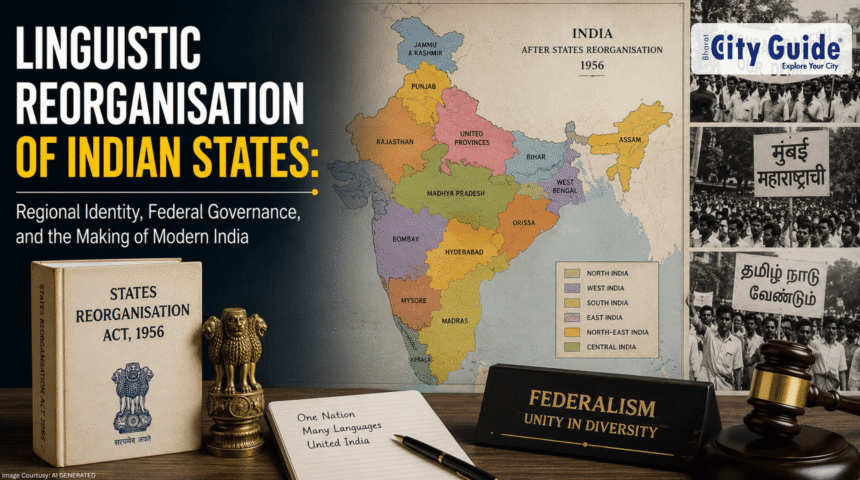
When India became independent in 1947, it inherited not only the legacy of colonial governance and partition but also a vast internal diversity of languages, cultures, histories, and regional aspirations. While political integration united hundreds of princely states and provinces into one sovereign republic, a major question remained unresolved: how should internal state boundaries be organized in a country where language was deeply tied to identity, culture, administration, and democratic representation?
- Introduction
- What Was the Linguistic Reorganisation of Indian States?
- Why the Linguistic Reorganisation of Indian States Became Necessary
- Early Debates After Independence
- The Andhra Movement and a Turning Point
- States Reorganisation Commission (SRC)
- States Reorganisation Act of 1956
- Regional Identity and Cultural Empowerment
- Governance Benefits of Linguistic States
- Political Transformation and Rise of Regional Parties
- Challenges and Risks
- Beyond Language: Economic and Governance Factors
- Center-State Relations and Federal Balance
- Long-Term Legacy of the Linguistic Reorganisation of Indian States
- Best Lessons from Linguistic Reorganisation
- Frequently Asked Questions About the Linguistic Reorganisation of Indian States
- Conclusion
The Linguistic Reorganisation of Indian States became one of the most significant political and constitutional transformations in post-independence India. It reshaped the federal structure by reorganizing state boundaries primarily along linguistic lines, recognizing that language was not merely a communication tool—it was a powerful marker of regional identity, social belonging, and political aspiration.
This reorganisation was not simply administrative redrawing. It fundamentally influenced governance, political mobilization, regional pride, federalism, democratic participation, and center-state relations. It also tested India’s ability to balance unity with diversity—a challenge central to the survival of one of the world’s most pluralistic democracies.
The story of linguistic reorganisation reveals how India adapted its political geography to social realities, helping transform potential fragmentation into a more representative federal order.
What Was the Linguistic Reorganisation of Indian States?
The Linguistic Reorganisation of Indian States refers to the post-independence process through which Indian state boundaries were redrawn primarily based on dominant regional languages rather than colonial administrative divisions.
Core Principle:
States should better reflect linguistic and cultural identities.
Why It Emerged:
Colonial provinces often grouped linguistically different populations together, creating governance and representation challenges.
Key Objective:
- Administrative efficiency
- Democratic legitimacy
- Cultural recognition
- Political stability
Historic Milestone:
The States Reorganisation Act of 1956 was the defining legal framework.
Why the Linguistic Reorganisation of Indian States Became Necessary
1. Language as Identity
For many communities, language represented:
- Culture
- Literature
- Heritage
- Political voice
2. Administrative Accessibility
Governance often works better when conducted in widely understood regional languages.
3. Democratic Representation
Linguistic states could strengthen public participation.
4. Political Stability
Recognizing identity-based aspirations could reduce unrest.
Early Debates After Independence
Initially, many national leaders were cautious.
Concerns Included:
- National fragmentation
- Regionalism
- Secession risks
- Administrative disruption
Strategic Tension:
Should India prioritize unity over linguistic demands?
Important Insight:
The challenge was balancing national integration with regional recognition.
The Andhra Movement and a Turning Point
A major turning point came with demands for a Telugu-speaking state.
Potti Sriramulu’s Fast
His death after a prolonged fast intensified public pressure.
Outcome:
Creation of Andhra State in 1953.
Historical Significance:
This demonstrated the political power of linguistic identity and accelerated broader reorganisation.
States Reorganisation Commission (SRC)
To address demands systematically, the government established the SRC in 1953.
Major Considerations:
- Language
- Administrative viability
- Economic potential
- National unity
Result:
Recommendations led to the States Reorganisation Act (1956).
Strategic Importance:
It institutionalized linguistic federalism.
States Reorganisation Act of 1956
This landmark legislation reshaped India’s map.
Key Effects:
- Redefined boundaries
- Created linguistically coherent states
- Strengthened administrative alignment
Broader Outcome:
It became a foundational moment in Indian federal development.
Regional Identity and Cultural Empowerment
Linguistic states gave communities stronger cultural recognition.
Positive Outcomes:
- Language preservation
- Educational alignment
- Literature growth
- Cultural confidence
Important Lesson:
Recognition can strengthen belonging within a larger nation.
Governance Benefits of Linguistic States
Administrative Advantages:
- Local language governance
- Better communication
- Improved public service delivery
- Increased citizen participation
Democratic Value:
Citizens may engage more effectively when governance reflects local identity.
Political Transformation and Rise of Regional Parties
Linguistic reorganisation reshaped politics.
Major Effects:
- Regional party emergence
- State-level political leadership
- Coalition politics
- Federal negotiation
Bigger Picture:
India’s democracy became more decentralized and pluralistic.
Challenges and Risks
Potential Downsides:
- Regionalism
- Identity politics
- Inter-state disputes
- Minority concerns within states
Strategic Reality:
Identity recognition does not eliminate political complexity.
Beyond Language: Economic and Governance Factors
Over time, state formation also involved:
- Development demands
- Administrative convenience
- Tribal identity
- Economic disparities
Examples:
Later state formations reflected broader governance concerns beyond language alone.
Center-State Relations and Federal Balance
Linguistic states strengthened federalism while also increasing regional political assertion.
Key Result:
India evolved into a more negotiated federal union.
Strategic Insight:
Flexibility became essential to national cohesion.
Long-Term Legacy of the Linguistic Reorganisation of Indian States
Major Achievements:
- Democratic accommodation
- Cultural recognition
- Administrative efficiency
- Federal stability
Broader Historical Significance:
India demonstrated that diversity could be institutionally integrated rather than suppressed.
Best Lessons from Linguistic Reorganisation
Strategic Priorities:
- Democratic responsiveness
- Cultural respect
- Constitutional flexibility
- Governance efficiency
- National unity
Formula:
Identity + Federalism + Representation + Stability
Frequently Asked Questions About the Linguistic Reorganisation of Indian States
What was linguistic reorganisation?
It was the redrawing of state boundaries primarily based on language.
Why was it important?
It strengthened representation, governance, and cultural recognition.
What triggered it?
Regional linguistic movements, especially Andhra.
What was the States Reorganisation Act?
The 1956 law that reorganized Indian states.
Did it weaken India?
No, many argue it strengthened federal democracy.
Were there challenges?
Yes, including regionalism and disputes.
Is linguistic identity still politically important?
Yes, language remains a major factor in regional politics.
Conclusion
The Linguistic Reorganisation of Indian States was one of the most consequential constitutional and political adaptations in India’s democratic journey. By recognizing linguistic identity within a federal framework, India transformed a potentially divisive challenge into an enduring model of democratic accommodation.
Rather than fragmenting the nation, linguistic reorganisation often strengthened it by making governance more representative and culturally resonant.
In embracing linguistic diversity while preserving national unity, India demonstrated a crucial principle of democratic statecraft: strong nations are not always built by erasing differences, but by thoughtfully integrating them.