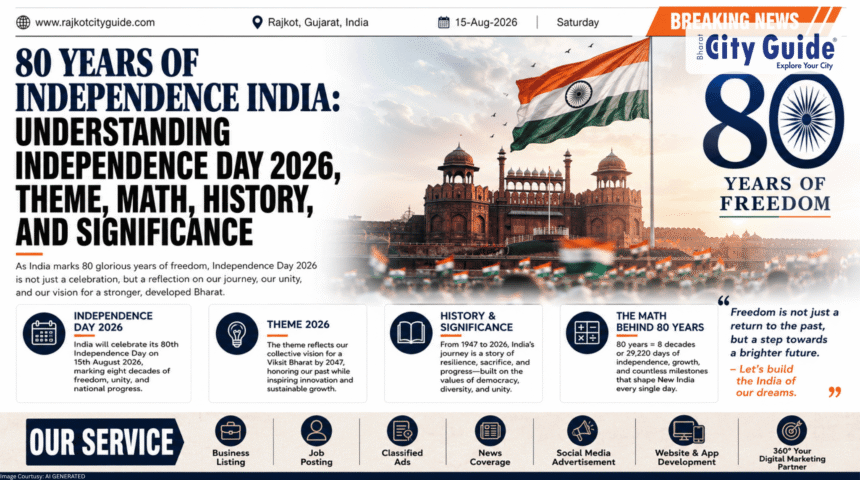
Every year as mid-August approaches, patriotic fervor sweeps across the nation. The tricolour flutters high from government offices, schools, housing societies, and iconic national monuments. Yet, right alongside the preparations, a familiar debate resurfaces in living rooms and across social media platforms: Is 2026 India’s 79th or 80th Independence Day?
- What is 80 Years of Independence India?
- Current Situation and Latest Updates for Independence Day 2026
- Why 80 Years of Independence India is Historically Significant
- Key Highlights of the 80th Independence Day Celebrations
- Detailed Breakdown of 80 Years of Independence India Key Themes
- National Progress Comparison: 1947 vs. 2026
- Slogans That Shaped the Path to 80 Years of Independence India
- Key Achievements During 80 Years of Independence India
- Challenges Remaining for India’s Next Decade
- How Indian Citizens Can Celebrate the 80th Independence Day
- Frequently Asked Questions (FAQs)
- Conclusion
Understanding the journey of 80 years of independence India requires both mathematical clarity and a deep appreciation for the historical milestones that built the modern Republic. India marks its Independence Day on August 15, 2026. This date is permanently etched into the consciousness of every Indian as a symbol of liberation after more than two centuries of British colonial rule.
This comprehensive guide breaks down the simple math behind the milestone, details the official theme for Independence Day 2026, reflects on the historical struggle, and outlines how India is leveraging its youthful energy to transition from a developing nation into a global powerhouse by 2047.
What is 80 Years of Independence India?
The concept of 80 years of independence india represents the historical and mathematical timeline of India’s journey as a sovereign nation from August 15, 1947, through August 15, 2026. It is a commemoration of decades spent building democratic institutions, advancing economic self-reliance, driving technological innovation, and preserving rich cultural diversity.
Historical Background
For nearly two centuries, the Indian subcontinent was subjected to British colonial exploitation. What began as trade dominance under the East India Company transitioned into direct imperial governance under the British Crown following the Uprising of 1857.
India’s independence was achieved through decades of sacrifice, non-violent civil disobedience, revolutionary movements, and persistent political negotiations led by figures like Mahatma Gandhi, Jawaharlal Nehru, Sardar Vallabhbhai Patel, Netaji Subhas Chandra Bose, Bhagat Singh, and millions of unsung citizens. Power was formally transferred at midnight on August 14–15, 1947, creating the independent Dominion of India under the Indian Independence Act passed by the British Parliament.
The Math Explained: 79th Anniversary vs. 80th Celebration
The annual confusion regarding whether 2026 marks the 79th or 80th Independence Day stems from mixing up the total number of completed years with the total number of celebration events.
- Completed Years of Freedom: When you perform simple subtraction ($2026 – 1947 = 79$), you get 79. This means that on August 15, 2026, India completes exactly 79 full years of sovereign freedom.
- Independence Day Occasions: The counting of celebrations begins on the very day freedom was achieved.
- August 15, 1947 = 1st Independence Day
- August 15, 1948 = 2nd Independence Day (1 year completed)
- August 15, 1997 = 51st Independence Day (50 years completed)
- August 15, 2026 = 80th Independence Day (79 years completed)
Therefore, while India completes 79 years of freedom, August 15, 2026, marks the observance of the 80th Independence Day.
Current Situation and Latest Updates for Independence Day 2026
The national celebrations for the 80th Independence Day at the historic Red Fort in New Delhi bring together rich tradition and forward-looking national goals. The Ministry of Defence and the Government of India have structured the 2026 event around key historical and strategic milestones.
Official Theme Announced: ‘Yuva Shakti for Viksit Bharat@2047’
The central theme for the 80th Independence Day is “Yuva Shakti for Viksit Bharat@2047”. This theme aligns national focus with the potential of India’s youth population. As India heads toward the centenary of its independence in 2047, young innovators, entrepreneurs, researchers, and workers are being positioned as the primary drivers of economic and social transformation.
Commemorating 150 Years of ‘Vande Mataram’
A major historical highlight of the 2026 celebrations is the national tribute to 150 years of Vande Mataram, India’s National Song. Penned by Bankim Chandra Chattopadhyay in the 1870s and featured in his classic novel Anandamath, the song served as a rallying cry during the Swadeshi Movement and the broader freedom struggle.
For the first time in the history of Independence Day ceremonies at the Red Fort, a special live mass rendition of Vande Mataram is incorporated into the official protocol. Thousands of NCC (National Cadet Corps) cadets and MY Bharat (Mindset of Youth for Bharat) volunteers gathered on the Gyanpath directly opposite the ramparts to form a human formation spelling out “वंदे मातरम्” in Hindi script.
Key Ceremonial Protocol Highlights
- Guard of Honour: The Prime Minister receives a general salute from a joint Inter-Services and Delhi Police Guard before inspecting the troops.
- Flag Hoisting and 21-Gun Salute: The Prime Minister unfurls the Indian Tricolour at the ramparts of the Red Fort, synchronized with the playing of the National Anthem and a traditional 21-gun salute.
- Aerial Petal Shower: Indian Air Force Mi-17 helicopters fly overhead carrying national banners and showering flower petals across the gathering.
- National Address: Prime Minister Narendra Modi delivers his 13th consecutive Independence Day address to the nation, outlining major achievements and national roadmaps.
Why 80 Years of Independence India is Historically Significant
Reaching 80 years of independence represents a profound milestone for the global geopolitical landscape. In 1947, many Western commentators doubted that a vast, diverse nation burdened by poverty, illiteracy, and colonial damage could maintain a unified democratic framework.
Celebrating 80 years of independence india highlights several core historical achievements:
- Enduring Democratic Foundations: India remains the world’s largest and most vibrant democracy, conducting peaceful transfers of power through free elections across decades.
- Transition from Scarcity to Surplus: From relying on foreign food aid in the mid-20th century, India executed the Green and White Revolutions to achieve total agricultural self-sufficiency.
- Global Economic Engine: India has advanced from a fragile post-colonial economy to one of the fastest-growing major economies globally.
- Scientific & Technological Leadership: Through organizations like ISRO and DRDO, along with a thriving digital economy, India has reached the Moon’s south pole, launched interplanetary missions, and pioneered global digital public infrastructure (such as UPI).
Key Highlights of the 80th Independence Day Celebrations
- Historic Milestone: Observance of the 80th Independence Day, marking 79 completed years of national sovereignty.
- Dual National Focus: A celebration balancing past patriotic legacy (150 Years of Vande Mataram) with future developmental goals (Yuva Shakti for Viksit Bharat@2047).
- Red Fort Redefinition: Inclusion of a live mass rendition of Vande Mataram on the ramparts for the first time.
- People-Centric Ceremonies: Renaming seating enclosures after major Indian lakes (such as Chilika, Pangong Tso, and Dalpat Sagar) to promote water conservation and move away from traditional VIP classifications.
- Special Citizen Guests: Attendance by over 5,000 special guests representing diverse sections of society, including grassroots innovators, sarpanches, frontline workers, and youth achievers.
Detailed Breakdown of 80 Years of Independence India Key Themes
+----------------------------------------------------------------------------------+
|                     80 YEARS OF INDEPENDENCE INDIA (2026)                       |
+---------------------------------------------------+------------------------------+
|             HONOURING THE PAST                    |      BUILDING THE FUTURE     |
|          150 Years of Vande Mataram               |    Yuva Shakti for Viksit    |
|   (National Song written by Bankim Chandra)       |          Bharat@2047         |
+---------------------------------------------------+------------------------------+
1. Yuva Shakti: Driving Youth-Led Growth
India currently possesses one of the youngest demographic profiles among major nations, with over 60% of its population under 35 years of age. The 80 years of independence india theme recognizes that demographic numbers alone do not create progress; active youth engagement does.
- Skill Acceleration: Transitioning youth from job seekers to job creators through national entrepreneurship networks, incubation centers, and technical vocational training.
- Global Innovation: Leveraging Indian talents in Software-as-a-Service (SaaS), Artificial Intelligence, clean energy transitions, and deep-tech research.
- Sports Infrastructure: Promoting grassroots athletic development to ensure Indian youth compete at elite global levels.
2. Viksit Bharat@2047: The Centenary Blueprint
The 80th Independence Day serves as a critical checkpoint on the 25-year roadmap leading to 2047—the centenary of Indian freedom. The Viksit Bharat (Developed India) roadmap targets transformation across four core pillars:
- Economic Prosperity: High per-capita income, expanded manufacturing capability, and robust infrastructure development.
- Social Equality: Inclusive access to quality healthcare, modern education, and digital access across rural and urban divides.
- Environmental Sustainability: Transitioning toward net-zero emissions, expanding solar and green hydrogen capacity, and executing massive water conservation drives.
- Good Governance: Digital transparency, reduced regulatory burdens, and citizen-centric public service delivery.
3. Cultural Heritage & The Legacy of Vande Mataram
Celebrating 80 years of independence india is incomplete without honoring the cultural movements that fueled the political fight for freedom.
- The Power of the Song: Vande Mataram gave expression to the idea of the motherland as a divine entity, uniting diverse regions speaking different languages under a shared national consciousness.
- Preserving Freedom Values: Integrating historic freedom struggle narratives into contemporary digital learning mediums to ensure future generations remain anchored to constitutional values and national unity.
National Progress Comparison: 1947 vs. 2026
To understand the scale of transformation over 80 years of independence india, consider how key socio-economic metrics have shifted across eight decades:
| Strategic Indicator | Status at Independence (1947) | Status at 80th Independence Day (2026) |
| Literacy Rate | Approx. 12% | Exceeds 80% with near-universal primary enrollment |
| Life Expectancy | ~32 Years | ~70+ Years due to expanded public healthcare |
| Food Security | Deficit; reliant on foreign grain imports | Net agricultural exporter feeding 1.4+ billion people |
| Tech & Digital Infrastructure | Minimal telegraphic networks | World leader in real-time digital payments (UPI) |
| Global Economic Ranking | Severely impoverished colonial territory | Among the top 5 largest global economies |
| Energy Generation | Micro-scale power grids | Massive grid capacity with rapidly growing renewable share |
Slogans That Shaped the Path to 80 Years of Independence India
The journey toward 80 years of independence india was built on powerful rallying cries that energized generations of freedom fighters:
- “Vande Mataram” (Bankim Chandra Chattopadhyay): Instilled deep patriotic devotion, turning the freedom struggle into a personal commitment for millions.
- “Swaraj is my birthright, and I shall have it” (Bal Gangadhar Tilak): Shifted the political movement from polite appeals to an assertive demand for self-governance.
- “Inquilab Zindabad” (Coined by Hasrat Mohani, popularized by Bhagat Singh): A call to overthrow systemic oppression and fight for justice.
- “Karo ya Maro” / “Quit India” (Mahatma Gandhi): The urgent call during the 1942 movement that signaled the final push against colonial rule.
- “Jai Hind” & “Give me blood, and I will give you freedom” (Netaji Subhas Chandra Bose): A military greeting and call to action that unified citizens across regions and religions.
Key Achievements During 80 Years of Independence India
India’s growth over eight decades spans multiple domain transformations:
- Space Exploration: Evolving from transporting rocket components on bicycles in the 1960s to successfully landing Chandrayaan-3 on the lunar south pole and launching solar observatories.
- Digital Public Infrastructure (DPI): Establishing the “India Stack”—combining Aadhaar digital identity, UPI payment processing, and DigiLocker—which now serves as a global model for financial inclusion.
- Industrial & Infrastructure Scale: Building world-class expressways, expanding high-speed Vande Bharat rail networks, and modernizing air networks under regional connectivity schemes.
- Pharmaceutical Leadership: Earning the title of “Pharmacy of the World” by producing affordable vaccines and generic medications for developing and developed nations alike.
- Defense Indigenous Development: Manufacturing native aircraft carriers (INS Vikrant), light combat aircraft (Tejas), and advanced missile systems.
Challenges Remaining for India’s Next Decade
While 80 years of independence india reflects significant achievement, addressing remaining structural challenges is vital to realizing the Viksit Bharat@2047 vision:
- Job Creation for Youth: Ensuring rapid economic growth translates directly into high-quality employment opportunities across manufacturing, technology, and services.
- Urban-Rural Income Disparity: Bridging infrastructure, healthcare, and educational gaps between major metropolitan areas and tier-3 towns or rural villages.
- Environmental & Climate Resilience: Managing urban air quality, protecting groundwater reserves, and mitigating heatwaves and extreme weather events.
- Quality of Education: Shifting focus from basic school enrollment to outcome-based learning, critical thinking, and industry-aligned technical skillsets.
How Indian Citizens Can Celebrate the 80th Independence Day
Independence Day is a national celebration meant for every citizen, business, community, and institution:
- Participate in ‘Har Ghar Tiranga’: Display the Indian Tricolour respectfully at homes and workplaces in accordance with the Flag Code of India.
- Support Youth-Led Initiatives: Mentor young professionals, buy from local Indian startups, and support youth community projects.
- Engage in Civic Duties: Commit to keeping public spaces clean through Swachhata initiatives, conserving water, and obeying civic laws.
- Explore Freedom History: Revisit patriotic literature, watch historical documentaries, or visit local national heritage sites with family and children.
Frequently Asked Questions (FAQs)
Q1: Is 2026 the 79th or 80th Independence Day of India?
In 2026, India celebrates its 80th Independence Day. The confusion happens when people subtract 1947 from 2026 to get 79. That calculation represents 79 completed years of freedom. However, because the original day of freedom—August 15, 1947—was the first Independence Day event, August 15, 2026, is officially the 80th celebration.
Q2: What is the theme for India’s 80th Independence Day in 2026?
The official theme for the 80th Independence Day in 2026 is “Yuva Shakti for Viksit Bharat@2047” alongside the historical commemoration of “150 Years of Vande Mataram”. The theme highlights the vital role of Indian youth in building a developed nation by the 100th anniversary of independence.
Q3: Why is 150 years of Vande Mataram being celebrated during Independence Day 2026?
The year 2026 marks the 150th anniversary of Vande Mataram, written by Bankim Chandra Chattopadhyay in the 1870s. As a central rallying song during the freedom struggle, its 150-year legacy is being honored at the Red Fort with special live renditions and floral tributes.
Q4: Who unhoists the National Flag on Independence Day at the Red Fort?
The Prime Minister of India unfurls the National Flag at the historic Red Fort in New Delhi on Independence Day (August 15) and addresses the nation from its ramparts. (By contrast, the President of India hoists the flag on Republic Day, January 26, at Kartavya Path).
Q5: What is the difference between Independence Day and Republic Day in India?
Independence Day (August 15) marks the day India gained freedom from British colonial rule in 1947. Republic Day (January 26) marks the day the Constitution of India officially came into effect in 1950, transforming the nation into a sovereign democratic republic.
Q6: What does the vision of Viksit Bharat@2047 mean?
Viksit Bharat@2047 is the national vision to transform India into a fully developed nation by 2047, marking 100 years of independence. It focuses on economic growth, social progress, sustainable development, modern infrastructure, and youth empowerment.
Q7: Why do India and Pakistan celebrate Independence Day on different dates?
While the Indian Independence Act set August 15, 1947, as the common liberation date, Pakistan celebrates its Independence Day on August 14. This was largely due to administrative logistics, as the last Viceroy, Lord Mountbatten, had to transfer power in Karachi on August 14 before attending the midnight ceremony in New Delhi.
Conclusion
The milestone of 80 years of independence india is a testament to the resilience, diversity, and spirit of over 1.4 billion people. From the midnight address in 1947 to the ongoing pursuit of Viksit Bharat@2047, India has transformed its national standing while remaining anchored to democratic values.
As the national flag flutters across towns, cities, and villages on August 15, 2026, the celebration of the 80th Independence Day bridges the sacrifices of the past with the aspirations of the future. By honoring 150 years of Vande Mataram and empowering Yuva Shakti, India honors its history while stepping forward into a new era of growth and global leadership.