Introduction
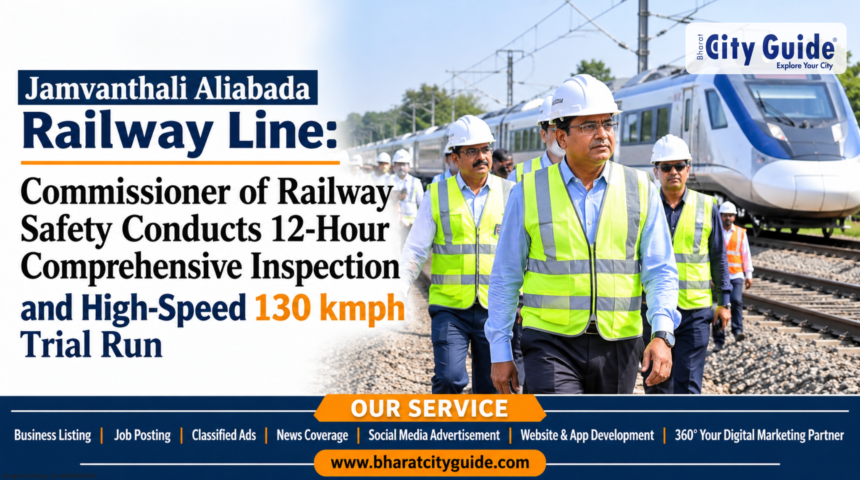
In a pivotal development for Saurashtra’s regional transport infrastructure, the Jamvanthali Aliabada Railway Line section under the Rajkot Division of Western Railway has undergone a rigorous 12-hour safety inspection led by the Commissioner of Railway Safety (CRS). As part of the ongoing Rajkot–Kanalus broad-gauge line doubling project, engineering authorities executed a high-speed trial run pushing test locomotives to speeds of 130 km/h. This comprehensive testing procedure marks the final operational validation phase required before the newly laid track can be commissioned for commercial passenger and freight train operations.
- Introduction
- What is Jamvanthali Aliabada Railway Line?
- Why This News is Important
- Background Information
- Key Highlights
- Detailed Breakdown of the 12-Hour Inspection and Trial Run
- Benefits and Importance of Railway Track Doubling
- How It Impacts Passengers, Industry, and Regional Economy
- Expert Insights and Railway Engineering Perspective
- Safety Guidelines and Public Advisories During Railway Trials
- Frequently Asked Questions (FAQs)
- Conclusion
The 12-hour statutory inspection encompasses an exhaustive evaluation of track geometry, structural integrity of rail bridges, signal interlocking systems, overhead electrification (OHE) parameters, and automated safety installations. High-speed testing on new railway tracks is far more than a routine ceremony; it is a critical safety assessment designed to observe dynamic interactions between heavy electric locomotives and the fresh track bed at maximum operational limits. Specialized Oscillation Monitoring System (OMS) equipment mounted on test rakes measures physical vibrations, track stability, and lateral movement under extreme speeds.
Once final safety clearances are issued by the Commission of Railway Safety, this key railway section will significantly increase line capacity between Rajkot, Jamnagar, and Kanalus. By removing single-line traffic bottlenecks, eliminating long waiting times at crossing stations, and enabling higher operational speeds for long-distance trains, the successful trial of the Jamvanthali–Aliabada stretch represents a major milestone in modernizing Gujarat’s western rail corridor.
What is Jamvanthali Aliabada Railway Line?
The Jamvanthali Aliabada Railway Line refers to a strategic 111-kilometer rail section undergoing track doubling and infrastructure modernization under the Rajkot–Kanalus Railway Doubling Project in Western Railway’s Rajkot Division. Located within Jamnagar district, the track connects the key rural junction stations of Jamvanthali and Aliabada, forming a critical bottleneck-relief corridor along the main trunk line connecting Rajkot with coastal ports, industrial hubs, and religious centers across Saurashtra.
+-----------------------------------------------------------------------+
|          JAMVANTHALI-ALIABADA RAILWAY LINE AT A GLANCE                |
+--------------------------+--------------------------------------------+
| Parent Infrastructure    | Rajkot–Kanalus Broad-Gauge Doubling Project|
| Project Length           | ~111 Kilometers Total Doubling Corridor    |
| Estimated Project Cost   | ₹1,168.13 Crore Approved Outlay            |
| Zonal Railway Division   | Rajkot Division, Western Railway           |
| Maximum Trial Speed      | 130 km/h High-Speed Testing                |
| Monitoring System        | Oscillation Monitoring System (OMS)        |
| Regulatory Body          | Commission of Railway Safety (CRS)         |
+--------------------------+--------------------------------------------+
Key features defining the newly upgraded line include:
- Broad-Gauge Track Doubling: Addition of a parallel broad-gauge track to eliminate single-line congestion and allow simultaneous two-way train movement.
- High-Speed Engineering Standards: Reinforced ballast beds, high-tensile continuous welded rails (CWR), heavy concrete sleepers, and upgraded curve transitions engineered to support speeds up to 130 km/h.
- Advanced OHE Electrification: Overhead electrification systems calibrated for smooth power draw by electric locomotives during high-speed transit.
- Modern Electronic Interlocking: Computerized signaling systems that enhance station crossover safety and minimize human error.
Why This News is Important
The execution of a 12-hour CRS inspection and 130 km/h trial run on the Jamvanthali–Aliabada section holds major significance for Western India’s transportation network. First, the Rajkot–Kanalus line carries heavy traffic volume, serving as the main rail link connecting interior Gujarat to major industrial ports (such as Sikka, Okha, and Rozi Pier), large oil refineries, fertilizer plants, and salt manufacturing units in Jamnagar and Devbhumi Dwarka. Single-line bottlenecks previously caused severe delays as passenger and freight trains waited for manual line clearances at intermediate stations.
Second, achieving successful 130 km/h test speeds opens the door for running high-speed express trains—such as Vande Bharat Express, superfast mails, and heavy freight rakes—at higher average operational speeds. Reducing travel times between Rajkot, Jamnagar, and coastal destinations boosts regional economic productivity and improves passenger travel comfort.
Finally, a mandatory 12-hour inspection by the Commissioner of Railway Safety ensures that public safety remains paramount. By testing structural bridges, embankment stability, signaling response, and track vibration under high speed, Indian Railways guarantees that the new infrastructure meets safety regulations before opening to daily passenger traffic.
Background Information
The Rajkot–Kanalus doubling project was sanctioned by Indian Railways at an estimated cost of ₹1,168.13 crore to address capacity constraints along Saurashtra’s busy rail network. For decades, single-track infrastructure between Rajkot Junction and Kanalus Junction created operational difficulties. Whenever long-distance trains from Mumbai, Ahmedabad, or Delhi entered the section, local passenger trains and industrial freight rakes had to be held up at side loops for crossing clearances.
+-----------------------------------------------------------------------+
|                 RAILWAY LINE CAPACITY & SPEED EVOLUTION               |
+--------------------------+--------------------------------------------+
| Operational Parameter    | Single-Line Legacy | Doubled Modern Line   |
+--------------------------+--------------------+-----------------------+
| Track Configuration      | Single Track       | Parallel Double Track |
| Max Sectional Speed      | 90–110 km/h        | Up to 130 km/h        |
| Train Crossing Delays    | Frequent Station   | Zero Crossing Delays  |
|                          | Holds Required     |                       |
| Freight Line Capacity    | Severely Constrained| High-Volume Continuous|
| Safety Monitoring        | Manual Checks      | OMS & Digital Sensors |
+--------------------------+--------------------+-----------------------+
To solve this issue, Western Railway prioritized phase-by-phase doubling along the 111-km corridor. Sections like Jamnagar–Aliabada and Rajkot–Khanderi underwent civil construction, track laying, electrification, and signaling upgrades. The completion of the Jamvanthali–Aliabada segment represents a major step toward finishing the entire broad-gauge double-line corridor.
Key Highlights
- Comprehensive 12-Hour Inspection: CRS team conducts a detailed statutory evaluation covering civil infrastructure, OHE lines, and digital signaling.
- 130 km/h High-Speed Trial Run: Electric locomotive test rake achieves 130 km/h speed targets along the newly laid track.
- OMS Sensor Data Capture: Oscillation Monitoring System tracks dynamic balance, vibration levels, and wheel-rail forces during high-speed runs.
- Key Part of ₹1,168 Crore Project: The section forms a key phase of the 111-km Rajkot–Kanalus broad-gauge doubling project.
- Eliminating Single-Line Congestion: Double-track operations will allow simultaneous movement of trains in both directions without station holds.
- Prerequisite for Regular Operations: Official clearance from the Railway Safety Commissioner is required before starting regular passenger services.
Detailed Breakdown of the 12-Hour Inspection and Trial Run
The statutory safety inspection and speed trial executed along the Jamvanthali–Aliabada stretch follow a rigid engineering protocol mandated by the Railway Board and the Ministry of Civil Aviation (under which the Commission of Railway Safety operates).
1. Civil and Structural Engineering Audit
During the morning hours of the 12-hour inspection, safety officers and senior divisional engineers perform detailed ground audits. The team inspects minor and major rail bridges, culverts, embankment slopes, ballast cushion depths, and track alignment on curves. Points and crossings at Jamvanthali and Aliabada stations are checked to verify proper rail seating and smooth switching.
+-----------------------------------------------------------------------+
|                   INSPECTION AND TRIAL RUN STAGES                     |
+--------------------------+--------------------------------------------+
| Inspection Phase         | Technical Verification & Operational Focus |
+--------------------------+--------------------------------------------+
| Phase 1: Physical Audit  | Track alignment, bridge loads & ballast    |
| Phase 2: Electrical Check| Overhead line tension, voltage & earthing  |
| Phase 3: Signal Audit    | Electronic interlocking & automatic signals|
| Phase 4: High-Speed Run  | 130 km/h trial with electric locomotive    |
| Phase 5: OMS Assessment  | Analyzing vibration & oscillation data     |
+--------------------------+--------------------------------------------+
2. Overhead Electrification (OHE) and Signaling Verification
Engineers conduct tests on the high-voltage OHE infrastructure, verifying wire height, stagger, section insulators, and transformer substation stability. Concurrently, electronic interlocking circuits and signal aspect transitions are tested to ensure automated fail-safe operation.
3. High-Speed 130 km/h OMS Trial Run
The main event of the inspection is the high-speed trial run. An electric locomotive coupled with a specialized test rake—equipped with an Oscillation Monitoring System (OMS)—accelerates up to 130 km/h along the section. OMS sensors measure vertical and lateral acceleration peaks, identifying any micro-level track unevenness. Senior Divisional Commercial Manager Sunil Kumar Meena noted that OMS evaluation ensures absolute dynamic stability before passenger trains are cleared to operate at elevated speeds.
Benefits and Importance of Railway Track Doubling
Upgrading single-line tracks to high-speed double-line corridors offers immense benefits for regional transportation:
1. Dramatic Reduction in Passenger Travel Times
Eliminating the need for trains to halt at side loops while waiting for oncoming traffic significantly cuts total journey times for passenger trains operating between Rajkot, Jamnagar, and Dwarka.
2. Increased Freight Capacity for Port and Industrial Belts
Double tracks allow continuous, heavy-haul freight movement from major industrial complexes, fertilizer units, and ports along the Saurashtra coastline, boosting regional trade efficiency.
3. Enhanced Operational Safety and Punctuality
Modern continuous-welded rails, reinforced concrete sleepers, and advanced electronic signaling reduce derailment risks and improve train punctuality across Western Railway.
4. Support for Modern High-Speed Rolling Stock
Constructing track beds capable of supporting 130 km/h speeds allows Indian Railways to deploy modern train sets—including Vande Bharat Express and Amrit Bharat push-pull rakes—along the Rajkot–Kanalus–Okha route.
How It Impacts Passengers, Industry, and Regional Economy
The commissioning of the double-track section positively influences multiple economic sectors:
- For Daily Passengers and Pilgrims: Shortens travel times and improves train punctuality for tourists and devotees traveling to major religious destinations like Dwarkadhish Temple and Nageshwar Jyotirlinga.
- For Industrial Refineries and Ports: Accelerates raw material imports and finished goods exports from Jamnagar’s industrial corridor to the national railway grid.
- For Indian Railways Operations: Increases line capacity utilization, lowers operational fuel costs through full electrification, and optimizes rolling stock usage.
- For Local Commerce and Agriculture: Provides fast, reliable freight transportation for regional agricultural produce, salt industries, and small-scale manufacturing units.
Expert Insights and Railway Engineering Perspective
Railway infrastructure experts highlight that executing a successful 130 km/h speed trial is a critical milestone for any modern railway line. According to civil engineers, operating trains at speeds above 110 km/h requires exceptional track geometry, precise rail welding, and calibrated transition curves to withstand dynamic lateral forces.
Senior railway officials emphasize that the 12-hour CRS inspection ensures total compliance with statutory safety parameters. Following the trial run, the Commissioner of Railway Safety compiles a comprehensive technical report detailing Oscillation Monitoring System (OMS) vibration readings, bridge deflection measurements, and track stability metrics. Upon reviewing these findings, the CRS issues an official authorization certificate, allowing Western Railway to schedule regular passenger and freight services on the new line.
Safety Guidelines and Public Advisories During Railway Trials
During high-speed railway trials and subsequent double-track commissioning, local communities and passengers should observe important safety precautions:
- Stay Clear of New Railway Tracks: Local residents, livestock owners, and pedestrian commuters must avoid trespassing on newly constructed railway lines during high-speed speed trials.
- Use Designated Level Crossings and Overbridges: Always cross double-track rail lines using authorized foot overbridges (FOBs), road overbridges (ROBs), or manned level crossing gates.
- Be Aware of High-Voltage Electric Wires: Never approach overhead electrification (OHE) lines, which carry 25,000-volt AC power, and maintain safe distances from railway electrical structures.
- Verify Train Schedules Before Traveling: Passengers should check updated Western Railway timetables via official railway portals or station inquiries as double-track commissioning reshapes arrival and departure schedules.
Frequently Asked Questions (FAQs)
What is the Jamvanthali Aliabada Railway Line speed trial?
It is a high-speed technical evaluation where test locomotives travel at 130 km/h to test the structural stability, track safety, and signaling systems of the newly doubled railway line.
What is the purpose of the 12-hour CRS inspection?
The 12-hour statutory inspection conducted by the Commissioner of Railway Safety ensures that civil tracks, bridges, OHE electric lines, and signaling systems meet strict safety regulations before regular train operations begin.
What is the Rajkot–Kanalus Doubling Project?
It is a ₹1,168.13 crore Western Railway infrastructure project covering approximately 111 km, aimed at converting the single-line track between Rajkot and Kanalus into a high-capacity double-track corridor.
How does the Oscillation Monitoring System (OMS) work during speed trials?
OMS equipment uses digital sensors mounted inside test rakes to measure physical vibrations, lateral movement, and wheel-rail forces while traveling at high speeds.
When will regular passenger trains start running on the new double line?
Regular passenger train services will begin once the Commissioner of Railway Safety reviews the technical trial results and issues official commercial commissioning authorization.
How does track doubling benefit freight and industrial traffic in Saurashtra?
Track doubling eliminates waiting times at crossing stations, allowing heavy freight trains serving local ports, refineries, and chemical plants to move continuously without blocking passenger trains.
Will speed trials allow Vande Bharat trains to run faster on this route?
Yes, certifying tracks for 130 km/h speeds creates the necessary infrastructure foundation to introduce or accelerate premium trains like Vande Bharat Express along the Rajkot–Jamnagar–Okha corridor.
Conclusion
The successful execution of the 12-hour inspection and 130 km/h speed trial along the Jamvanthali Aliabada Railway Line section marks a major triumph for Western Railway and Saurashtra’s regional transport network. By transforming this vital link into a high-speed, double-track broad-gauge corridor, Indian Railways is tackling historical line congestion and building a faster, safer, and more efficient transport infrastructure.
This project reflects the state’s broader commitment to modernizing essential transit grids.
As final safety authorizations are finalized by the Commission of Railway Safety, passengers and industrial shippers can look forward to faster travel times, improved train punctuality, and enhanced regional connectivity. The upgraded Jamvanthali–Aliabada rail section stands as a shining example of modern civil engineering, driving economic growth and seamlessly connecting Saurashtra’s vibrant communities for years to come.