Introduction
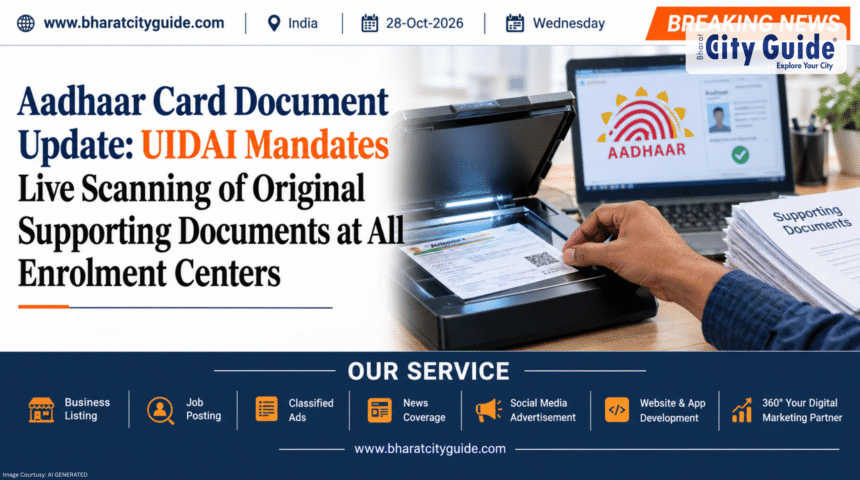
In a decisive move to strengthen national identity security and eliminate fraudulent updates, the Unique Identification Authority of India (UIDAI) has enforced a strict operational mandate regarding the Aadhaar Card Document Update process across all enrolment and update centers. Under the revised Standard Operating Procedures (SOPs), citizens visiting Aadhaar Seva Kendras (ASKs), bank branches, post offices, and authorized civic update booths must present original, physical supporting documents for live electronic scanning. Photocopies, self-attested paper duplicates, or xerox copies are no longer accepted under any circumstances for updating demographic or biometric credentials.
- Introduction
- What is Aadhaar Card Document Update?
- Why This News is Important
- Background Information
- Key Highlights
- Detailed Explanation of the Live Scanning Verification Process
- Permissible Documents and Recognized Category Framework
- Benefits and Importance of the Original Scanning Mandate
- How It Impacts Citizens, Students, and Centers
- Expert Insights and Security Perspective
- Essential Guidelines for Visiting Update Centers
- Frequently Asked Questions (FAQs)
- Conclusion
This policy update addresses widespread instances of forged, altered, or substandard photocopies being used to alter critical personal details—such as names, dates of birth, residential addresses, and mobile numbers. By requiring center operators to scan original Proof of Identity (PoI) and Proof of Address (PoA) documents directly into UIDAI’s secure portal in high resolution, the authority ensures complete authenticity, traceability, and immediate digital verification. Operators must verify the physical document in the presence of the resident before returning the original papers immediately upon completing the electronic scan.
This mandate carries significant operational implications for millions of citizens across urban and rural centers in India. As government benefit transfers, banking e-KYC, passport issuance, and tax filings rely heavily on verified Aadhaar records, enforcing original document verification protects the national identity framework. Citizens planning to update their records at local centers are strongly advised to check the official list of permissible original documents beforehand to avoid application rejections or multiple visits.
What is Aadhaar Card Document Update?
The Aadhaar Card Document Update refers to the process established by UIDAI allowing residents to refresh, correct, or upload supporting Proof of Identity (PoI), Proof of Address (PoA), Proof of Relationship (PoR), and Date of Birth (DoB) documents in their official Aadhaar profile. This process applies both to routine demographic updates (such as changing a home address, updating a mobile number, or correcting name spellings) and to the 10-year periodic document re-validation recommended by UIDAI.
Key rules governing the document update process include:
- Mandatory Original Document Scanning: Operators at authorized physical centers must perform live, high-resolution color scans of physical original documents.
- Rejection of Photocopies: Paper photocopies, black-and-white duplicates, notary-attested xerox sheets, and edited digital prints are strictly rejected by update client software.
- Dual Update Channels: Document updates can be performed online via the official myAadhaar portal (for self-service address updates) or offline at authorized centers (for full demographic and biometric updates).
- Immediate Document Return: Original physical documents are handed back to the resident immediately after live scanning is completed at the center operator console.
Why This News is Important
The strict enforcement of original document scanning at update centers carries immense security, governance, and civic importance across the country. First, the Aadhaar system serves as the foundational identity verification mechanism for over 300 government welfare programs, Direct Benefit Transfer (DBT) schemes, Ayushman Bharat healthcare cards, and PM-KISAN agricultural subsidies. Allowing unverified photocopies created vulnerabilities where fraudulent agents could manipulate addresses or names to claim welfare benefits illegally.
Second, requiring original document scanning significantly reduces update request rejection rates caused by illegible or smudged photocopies. When operators capture high-definition color scans directly from valid original passports, voter ID cards, or electricity bills, UIDAI’s automated verification engines can process and approve update requests much faster.
Finally, this rule protects citizens against identity theft, unauthorized address changes, and financial fraud. Ensuring that only the legitimate owner holding the original government-issued document can initiate a profile update prevents bad actors from altering contact numbers or residential details without authorization.
Background Information
Since the launch of the Aadhaar system, UIDAI has progressively updated its enrollment and update procedures to keep pace with evolving cybersecurity challenges. In earlier years, residents submitted self-attested paper photocopies alongside their update application forms at local centers. Operators uploaded low-resolution greyscale scans of these paper copies into the system.
However, audit reviews revealed that low-quality photocopies occasionally allowed modified text, altered dates, and fraudulent stamps to slip past initial verification checks. To eliminate these security loopholes, UIDAI updated its client software across all authorized enrollment terminals, making the system require high-resolution color document inputs.
+-----------------------------------------------------------------------+
|             AADHAAR DOCUMENT UPDATE RULES AT A GLANCE                 |
+--------------------------+--------------------------------------------+
| Issuing Authority        | Unique Identification Authority (UIDAI)     |
| Scanning Requirement     | Mandatory Live Scanning of Original Papers |
| Unacceptable Documents   | Photocopies, Xerox Copies, Digital Prints  |
| Official Update Fee      | ₹75 at Centers; Free Online via myAadhaar |
| Processing Channels      | ASKs, Bank Branches, Post Offices & Portal |
| Document Return Policy   | Originals Returned Immediately After Scan  |
+--------------------------+--------------------------------------------+
Under these guidelines, enrollment software enforces strict document validation protocols. Operators who attempt to scan photocopies face administrative penalties, system suspension, and blacklisting, ensuring strict compliance at centers nationwide.
Key Highlights
- Mandatory Original Document Scanning: All update requests require presenting original physical proof documents at the center.
- Absolute Ban on Photocopies: Paper photocopies, xerox duplicates, and notary-certified copies are officially banned from scanning.
- Immediate Return of Papers: Center operators scan the original document and return it to the applicant immediately.
- Updated Fee Structure: Demographic and document updates at physical centers attract a standard official charge of ₹75.
- Categorized Name Change Rules: Name corrections follow strict categories (minor spelling vs. major gazette changes) with specific document requirements.
- Free Online Document Portal: Self-service document updates on the official myAadhaar portal remain free of charge until June 14, 2027.
Detailed Explanation of the Live Scanning Verification Process
The revised verification workflow at authorized Aadhaar update centers is designed to be transparent, secure, and user-friendly. When a resident arrives at an Seva Kendra or post office update counter, the operator reviews the physical original document against the information requested on the update form.
Once verified, the operator places the physical original document—such as an original Passport, Voter ID Card, PAN Card, Ration Card, or Bank Passbook—onto a color flatbed scanner connected directly to the UIDAI client software. The software captures a high-resolution, full-color digital image of the document.
+-----------------------------------------------------------------------+
|                  STEP-BY-STEP VERIFICATION WORKFLOW                   |
+--------------------------+--------------------------------------------+
| Workflow Stage           | Operational Action Required at Center      |
+--------------------------+--------------------------------------------+
| Step 1: Verification     | Resident presents physical original proof  |
| Step 2: Form Check       | Operator verifies details against original |
| Step 3: Color Scanning   | Live high-res scan of physical original    |
| Step 4: Paper Return     | Original document handed back to resident  |
| Step 5: Biometric Auth   | Resident verifies update via fingerprint   |
| Step 6: Receipt Generation| Acknowledgement slip (URN) printed for user|
+--------------------------+--------------------------------------------+
The system automatically checks image clarity, lighting, and document boundaries. After scanning, the operator returns the physical document to the applicant. The resident then completes biometric authentication (fingerprint or iris scan) to sign the update request electronically. Finally, an Update Request Number (URN) receipt is generated for tracking the application status online.
Permissible Documents and Recognized Category Framework
To ensure a smooth update experience, citizens must carry valid original documents recognized under UIDAI’s official document list. Documents are broadly classified under four primary categories:
1. Proof of Identity (PoI)
- Original Passport
- Original PAN Card
- Original Voter ID Card
- Original Driving License
- Government Photo ID Card or Service ID Card
2. Proof of Address (PoA)
- Original Bank Passbook with applicant’s photo and branch seal
- Recent Utility Bills (Electricity, Water, or Gas bill not older than 3 months)
- Property Tax Receipt or Rent Agreement
- Original Ration Card
- Official Allotment Letter from Central or State Government
+-----------------------------------------------------------------------+
|                   PERMISSIBLE PROOF DOCUMENTS LIST                    |
+--------------------------+--------------------------------------------+
| Category Type            | Accepted Original Documents                |
+--------------------------+--------------------------------------------+
| Proof of Identity (PoI)  | Passport, PAN Card, Voter ID, Driving Lic. |
| Proof of Address (PoA)   | Electricity Bill, Bank Passbook, Ration Card|
| Proof of Date of Birth   | Birth Certificate, Passport, SSLC Marksheet|
| Major Name Change        | Official Gazette Notification + Old PoI    |
+--------------------------+--------------------------------------------+
3. Proof of Date of Birth (DoB)
- Original Birth Certificate issued by Registrar of Births
- School Leaving Certificate (SLC) or Class 10 SSLC Marksheet
- Original Passport
Benefits and Importance of the Original Scanning Mandate
Enforcing live scanning of original documents offers multiple benefits for citizens, civic administration, and national security:
1. Faster Processing and Approval Rates
High-resolution color scans of original documents allow UIDAI verifiers to confirm details quickly, significantly cutting down application rejections and processing delays.
2. Enhanced Protection Against Identity Fraud
Requiring the physical original document prevents bad actors from using edited photocopies to alter contact details or residential records illegally.
3. Streamlined Banking and Welfare e-KYC
Verified records ensure seamless authentication for bank account opening, mutual fund investments, passport applications, and direct subsidy transfers.
4. Zero Document Retention Risk
Because operators scan and return original documents immediately, citizens do not have to leave personal original papers at update centers, eliminating risks of document loss.
How It Impacts Citizens, Students, and Centers
The original document requirement introduces positive, practical changes across the public ecosystem:
- For General Citizens and Residents: Requires bringing valid, damage-free original documents to centers, preventing application rejections and saving repeat visits.
- For Students and Youth: Ensures school marksheet updates, JEE/NEET registrations, and scholarship distributions proceed smoothly with accurate identification.
- For Center Operators: Provides clear operational boundaries, protecting staff from fraudulent documentation issues while maintaining high service standards.
- For Senior Citizens: Guarantees that pension disbursements, healthcare access, and banking services remain uninterrupted through verified records.
Expert Insights and Security Perspective
Cybersecurity experts and governance analysts strongly support UIDAI’s original document scanning mandate. According to digital identity researchers, biometric identity systems are only as secure as the underlying demographic verification documents used during updates. Eliminating unverified paper photocopies removes a significant vulnerability in the identity verification chain.
Legal experts also note that these operational rules protect citizens’ rights. In cases of property disputes, financial fraud, or impersonation, having verified original document scans in the central identity repository provides legal clarity.
Furthermore, civic administrators emphasize that citizens updating their addresses online should upload clear, unedited PDF or color image scans of valid original documents via the official myAadhaar portal to avoid online application rejections.
Essential Guidelines for Visiting Update Centers
To ensure a smooth update experience without delays or rejections, residents should follow these practical guidelines:
- Verify Original Document Conditions: Ensure your original physical documents are free from tears, heavy smudges, or overwritten text that could obscure details during scanning.
- Ensure Matching Name Details: Verify that the spelling of your name, date of birth format, and residential address on the supporting original document match the details requested on the update form.
- Use Official Portal for Appointment Booking: Book an online appointment at your nearest Aadhaar Seva Kendra through the official myAadhaar portal (
myaadhaar.uidai.gov.in) to skip long waiting queues. - Obtain Official Payment Receipts: Always request and collect a printed acknowledgement receipt containing the URN and itemized official fee breakdown (₹75 for demographic/document updates) from the center operator.
Frequently Asked Questions (FAQs)
Why has UIDAI made original document scanning mandatory at update centers?
Original document scanning was made mandatory to eliminate fake, edited, or unreadable photocopies, ensuring that all identity updates are backed by verified proof documents.
Will the update center keep my original documents after scanning?
No, the operator scans the physical original document on a color scanner and returns the document to you immediately.
Can I submit a notary-attested photocopy for an Aadhaar Card Document Update?
No, notary-attested photocopies, xerox duplicates, and greyscale paper copies are not accepted at update centers.
What is the fee for an Aadhaar Card Document Update at a physical center?
The official fee for updating demographic details or uploading supporting documents at an authorized center is ₹75.
Is document updating available online for free?
Yes, residents can upload supporting proof documents self-service on the official myAadhaar portal for free until June 14, 2027.
What documents are accepted as valid Proof of Address (PoA)?
Accepted original documents include electricity bills (under 3 months old), bank passbooks with photos, water bills, property tax receipts, rent agreements, and ration cards.
How can I track my Aadhaar Card Document Update request status?
You can track your update status on the official myAadhaar portal or the mAadhaar app using the 14-digit Update Request Number (URN) printed on your acknowledgment slip.
Conclusion
The mandatory rule enforcing live scanning of original supporting documents for every Aadhaar Card Document Update represents an essential step forward in securing India’s digital identity framework. By banning unverified photocopies and requiring high-resolution color scans of original papers, UIDAI protects citizens against identity fraud while speeding up legitimate update approvals.
This operational mandate ensures that every record in the national database remains accurate, authentic, and secure.
As citizens prepare to update demographic details or complete their 10-year document re-validations, bringing valid physical original documents to update centers will ensure a hassle-free experience. Following UIDAI guidelines, verifying document details beforehand, and utilizing online appointment booking will keep identity records accurate, protecting seamless access to welfare benefits, banking services, and civic conveniences across India.