Introduction
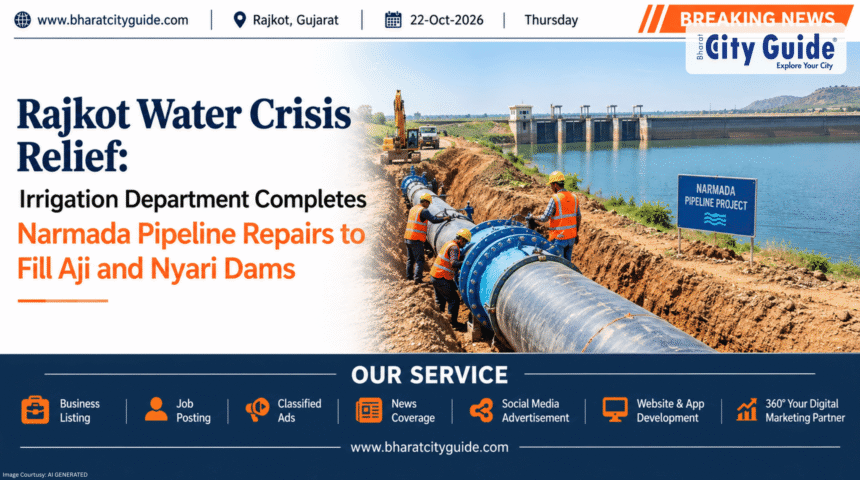
In a major development that brings immense comfort to over one and a half million residents across Saurashtra’s commercial capital, the Rajkot Water Crisis Relief effort has achieved a critical operational breakthrough. The Gujarat State Irrigation Department, in active coordination with the Rajkot Municipal Corporation (RMC), has successfully completed extensive repair works on the primary Narmada feeder pipeline network. With technical maintenance finished and pressure testing cleared, state authorities have signaled that Narmada water will be pumped directly into Aji-1 and Nyari-1 reservoirs within a day or two under the flagship SAUNI Yojana.
- Introduction
- What is Rajkot Water Crisis Relief?
- Why This News is Important
- Background Information
- Key Highlights
- Detailed Explanation of the Pipeline Repair and Inflow Plan
- Benefits and Importance of the Water Supply Boost
- How It Impacts People
- Expert Insights and Civil Engineering Perspective
- Challenges and Future Infrastructure Management
- Frequently Asked Questions (FAQs)
- Conclusion
The completion of these essential pipeline repairs resolves anxious municipal concerns regarding urban water security. In recent weeks, depleting storage levels at local reservoirs—caused by dry spells and high seasonal consumption—had raised fears of impending water rationing or supply cutbacks across several municipal wards. By restoring the bulk pipeline infrastructure, engineering teams can now discharge high-volume Narmada floodwaters directly into the city’s primary intake basins.
This timely infrastructure intervention guarantees seamless, daily tap water distribution for households, industrial units, and commercial establishments throughout Rajkot. As the Irrigation Department prepares to open the intake valves and initiate high-capacity pumping stations, this project demonstrates the crucial role played by regional bulk water grids in protecting urban populations from seasonal droughts.
What is Rajkot Water Crisis Relief?
The Rajkot Water Crisis Relief refers to the administrative, technical, and engineering intervention executed by the Gujarat Irrigation Department and Rajkot Municipal Corporation to secure the city’s drinking water supply. By completing emergency repairs on damaged pipeline sections along the Narmada bulk water transmission grid, authorities have paved the way to refill the city’s two primary reservoirs—Aji-1 Dam and Nyari-1 Dam—using water diverted from the Sardar Sarovar Narmada project via the SAUNI Yojana (Saurashtra Narmada Avtaran Irrigation) network.
Rajkot relies heavily on surface water storage from Aji-1, Nyari-1, and Bhadar dams to meet its daily municipal consumption requirements exceeding 130 to 140 million liters per day (MLD). When local monsoon inflows fall short or when pipeline leaks disrupt supply lines, local reservoirs deplete rapidly toward critical dead-storage levels.
The current relief effort restores full operational capacity to the bulk transmission pipeline. Pumping vast volumes of Narmada water through the SAUNI Link pipeline fills up local reservoirs to comfortable operational levels, shielding urban residents from seasonal water scarcity.
Why This News is Important
The successful completion of pipeline repairs and the imminent release of Narmada water hold immense social, economic, and civic significance for Rajkot. First, water security is the foundational pillar of urban health and economic stability. Guaranteed daily tap water access protects over 15 lakh citizens from the health hazards and financial strains associated with emergency private water tankers or irregular rationing schedules.
Second, Rajkot serves as Saurashtra’s major industrial, manufacturing, and commercial engine, hosting thousands of engineering MSMEs, casting foundries, textile units, and jewelry workshops. Uninterrupted municipal water distribution is essential to keep industrial processing plants operating smoothly without costly downtime or operational disruptions.
Finally, this achievement demonstrates the practical success of state bulk water grid planning. By utilizing the SAUNI Yojana pipeline infrastructure to transfer surplus river basin water to deficit urban reservoirs, Gujarat showcases a resilient model for managing seasonal climate variability and safeguarding regional water supplies.
Background Information
Historically, Rajkot and the wider Saurashtra region faced chronic, severe drinking water shortages during dry months. Before the integration of the Narmada canal network and the SAUNI Yojana, the city relied almost entirely on localized monsoon rainfall to fill the Aji, Nyari, and Bhadar reservoirs. In years marked by weak monsoons, local dams would dry up, forcing municipal authorities to transport drinking water via long-distance railway tankers from Gandhinagar or drill emergency deep tubewells.
To eliminate this vulnerability, the State Government launched the SAUNI Yojana—a massive engineering initiative designed to channel surplus Narmada floodwaters through thousands of kilometers of underground pressurized pipelines to fill 115 major dams across Saurashtra.
+-----------------------------------------------------------------------+
|             RAJKOT WATER SUPPLY RELIEF AT A GLANCE                    |
+--------------------------+--------------------------------------------+
| Responsible Agencies     | Gujarat Irrigation Dept & Rajkot Muni. Corp|
| Primary Water Sources    | Aji-1 Dam, Nyari-1 Dam & Bhadar Reservoir  |
| Feeder Network           | SAUNI Yojana Narmada Bulk Pipeline Grid    |
| Operational Status       | Pipeline Repairs Completed; Pumping Ready  |
| Target Timeline          | Water Inflow Initiated within 1 to 2 Days  |
| Key Beneficiaries        | 15 Lakh+ Residents & Industrial MSME Units |
+--------------------------+--------------------------------------------+
Recently, physical damage, joint leakages, and wear-and-tear along key feeder pipeline segments caused a temporary pause in bulk water transfers. Recognizing that localized water reserves in Aji and Nyari were approaching low levels, the Irrigation Department deployed specialized engineering crews to execute swift, round-the-clock repairs.
Key Highlights
- Pipeline Maintenance Completed: Emergency repair and joint sealing works on the main Narmada feeder pipeline are officially complete.
- Immediate Water Pumping: Irrigation Department signals that Narmada water discharge into Aji-1 and Nyari-1 dams will start within 24 to 48 hours.
- Powered by SAUNI Yojana: Water will be lifted from the Narmada canal network and channeled via pressurized underground pipelines.
- Citywide Supply Assurance: Replenishing local reservoirs guarantees uninterrupted, daily municipal tap water across all 18 RMC wards.
- Zero Rationing Required: Swift completion of pipeline repairs eliminates the need for municipal water cuts or reduced distribution hours.
- Support for Local Industry: Ensures stable water availability for Rajkot’s extensive manufacturing, foundry, and commercial sectors.
Detailed Explanation of the Pipeline Repair and Inflow Plan
The repair operations carried out along the Narmada pipeline corridor involved high-precision civil and mechanical engineering work. Specialized teams identified structural stress points, valve glitches, and pipe degradation along the bulk transmission lines that convey water from the main Narmada canal off-takes toward the Rajkot headworks.
Engineering crews replaced damaged pipe sections, reinforced high-pressure joint seals, cleared internal sediment blockages, and performed comprehensive hydrostatic pressure tests. With structural integrity re-established, the Irrigation Department alerted pumping station engineers to prepare high-capacity electric pumps to lift water into the SAUNI Link pipeline.
+-----------------------------------------------------------------------+
|                   NARMADA WATER DISCHARGE WORKFLOW                    |
+--------------------------+--------------------------------------------+
| Stage                    | Engineering & Operational Action           |
+--------------------------+--------------------------------------------+
| Stage 1: Pipe Repairs    | Structural fixing, welding & valve checks  |
| Stage 2: Pressure Tests  | Hydrostatic testing of bulk supply lines   |
| Stage 3: Pump Activation | Energizing high-capacity lifting stations  |
| Stage 4: Reservoir Inflow| High-volume discharge into Aji-1 & Nyari-1 |
| Stage 5: Municipal Supply| Filtration & equalized distribution by RMC |
+--------------------------+--------------------------------------------+
Once the valves open, millions of cubic feet (MCFT) of Narmada water will flow continuously into the catchment basins of Aji-1 and Nyari-1 dams. RMC water works department engineers will then draw raw water into modern filtration plants—including those at Aji, Nyari, and Ribda—processing and distributing clean drinking water through the city’s municipal pipeline network.
Benefits and Importance of the Water Supply Boost
Restoring pipeline operations and refilling local reservoirs offers multi-dimensional advantages for public health, municipal administration, and economic productivity:
1. Reliable Daily Municipal Water Access
Replenishing Aji-1 and Nyari-1 dams restores reservoir levels to optimal operational capacity, ensuring that households receive predictable daily tap water without relying on private water tankers.
2. Safeguarding Public Health and Sanitation
Consistent municipal supply ensures that clean, filtered drinking water reaches all neighborhoods, preventing health hazards associated with stagnant borewells or contaminated water sources.
3. Protecting Household Budgets
Providing consistent municipal water prevents residents from spending thousands of rupees on private tanker services or installing expensive home booster systems.
4. Grounding Regional Economic Stability
Industries, commercial markets, hotels, hospitals, and educational institutions in Rajkot can operate with complete confidence, knowing that city water infrastructure remains fully operational.
How It Impacts People
This major infrastructural milestone brings tangible, positive impacts across different segments of the local population:
- For Families and Homemakers: Delivers peace of mind through predictable, daily municipal water distribution, simplifying everyday household routines.
- For Small Business Owners and Industry: Ensures uninterrupted operations for local foundries, engineering workshops, food processing units, and service businesses.
- For the Rajkot Municipal Corporation (RMC): Reduces administrative pressure on civic officials, allowing engineering teams to focus on regular filter maintenance and pipeline upgrades rather than emergency crisis management.
- For Surrounding Agricultural Belts: Secures urban water needs through the pipeline grid, preventing excessive groundwater extraction and preserving regional rural water tables.
Expert Insights and Civil Engineering Perspective
Hydrology experts and urban planning specialists strongly commend the proactive approach taken by the Irrigation Department and Rajkot Municipal Corporation (RMC). According to civil engineers, maintaining bulk water transmission lines requires rigorous preventative maintenance, especially given the high hydraulic pressures carried by long-distance SAUNI pipelines.
Environmental scientists also highlight the ecological benefits of refilling urban reservoirs via bulk river transfers. Discharging fresh Narmada water into the Aji and Nyari dam basins improves overall water quality, dilutes local pollutants, and recharges surrounding groundwater aquifers across Rajkot district.
Furthermore, public administration analysts note that the rapid resolution of pipeline repairs demonstrates effective inter-agency coordination between state irrigation authorities and municipal governance bodies, setting a benchmark for responsive urban utility management.
Challenges and Future Infrastructure Management
To maintain long-term water security across Rajkot, authorities must address several ongoing operational priorities:
- Continuous Pipeline Integrity Audits: Implementing automated pressure sensors and acoustic leak-detection technology along the bulk pipeline grid to identify structural flaws before major bursts occur.
- Upgrading Urban Distribution Networks: Accelerating the replacement of aging municipal distribution pipes in older city zones to reduce distribution losses (Non-Revenue Water).
- Promoting Water Conservation Habits: Encouraging rainwater harvesting, smart water metering, and sensible domestic water use across residential societies.
- Expanding Reservoir Storage Capacities: Periodically de-silting local dam basins like Aji-1 and Nyari-1 to maximize raw water holding capacity during monsoon inflows.
Frequently Asked Questions (FAQs)
What major news has been announced regarding Rajkot’s water supply?
The Irrigation Department has successfully completed emergency repair works on the Narmada bulk pipeline, paving the way to discharge Narmada water into Aji-1 and Nyari-1 dams within a day or two.
How does Narmada water reach Rajkot’s local dams?
Water is lifted from the Narmada canal grid and conveyed through pressurized underground bulk pipelines under the state’s SAUNI Yojana project directly into the reservoir basins of Aji and Nyari dams.
Which local reservoirs supply drinking water to Rajkot?
Rajkot’s primary drinking water sources are the Aji-1, Nyari-1, and Bhadar reservoirs, supported by bulk transfers from the Narmada canal network.
Will there be any water cuts in Rajkot following this update?
No, the timely completion of pipeline repairs and the inflow of Narmada water eliminate the need for water cuts or supply reductions across the city.
What is the SAUNI Yojana?
The SAUNI Yojana (Saurashtra Narmada Avtaran Irrigation) is a major engineering project that channels surplus Narmada floodwaters through underground pipelines to fill 115 dams across Saurashtra for drinking and irrigation needs.
How much water does Rajkot consume daily?
Rajkot Municipal Corporation processes and distributes over 130 to 140 million liters of water daily (MLD) through its filtration and distribution plants.
How do pipeline repairs benefit common citizens?
Repairs restore full bulk water flow, ensuring that households receive regular, daily municipal tap water without depending on expensive private water tankers.
Conclusion
The successful execution of pipeline repairs and the imminent arrival of Narmada water into Aji and Nyari dams mark a decisive victory for Rajkot Water Crisis Relief. Through prompt engineering action and seamless coordination between the Irrigation Department and the Rajkot Municipal Corporation, the city has successfully protected its water security.
This infrastructure success highlights the vital importance of the SAUNI Yojana in transforming Saurashtra’s water landscape, turning potential seasonal scarcity into reliable urban water supply.
As Narmada water begins flowing into local reservoirs over the coming days, residents across Rajkot can look forward to secure, uninterrupted daily tap water access. This milestone ensures that the city remains healthy, resilient, and fully prepared to support its growing population and economic ambitions for months to come.