Introduction
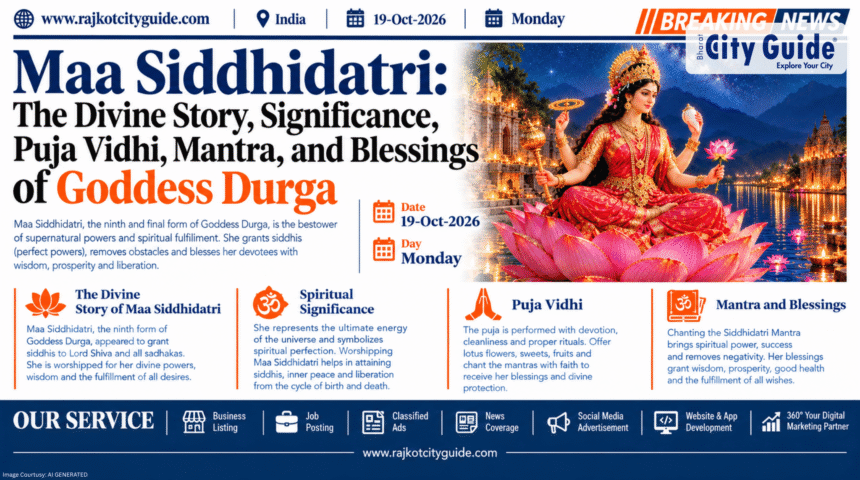
Maa Siddhidatri is worshipped as the ninth and final manifestation of Goddess Durga and holds a special place in Hindu religious traditions. She represents spiritual perfection, divine wisdom, fulfilment, and the blessings of supernatural and spiritual accomplishments known as siddhis. During Navratri, devotees worship the nine forms of Goddess Durga over nine days, with Maa Siddhidatri honoured on the ninth day, commonly associated with Maha Navami. Her worship marks the completion of this sacred journey of devotion, discipline, prayer, and spiritual reflection.
- Introduction
- Who Is Maa Siddhidatri?
- The Divine Story of Maa Siddhidatri
- The Meaning and Significance of Maa Siddhidatri
- The Divine Appearance of Maa Siddhidatri
- The Eight Siddhis Granted by Maa Siddhidatri
- Maa Siddhidatri and the Nine Forms of Goddess Durga
- Why Is Maa Siddhidatri Worshipped on Maha Navami?
- Maa Siddhidatri Puja Vidhi: How to Worship at Home
- Maa Siddhidatri Mantra and Its Meaning
- What Bhog Is Offered to Maa Siddhidatri?
- Spiritual Benefits of Worshipping Maa Siddhidatri
- The Message of Maa Siddhidatri for Modern Life
- Conclusion
The name Maa Siddhidatri combines two Sanskrit words: siddhi, meaning accomplishment, perfection, or spiritual attainment, and datri, meaning giver. Therefore, she is revered as the divine mother who grants siddhis and guides devotees towards wisdom, peace, and spiritual growth. Her traditional iconography depicts her with four arms, holding a discus, conch, mace, and lotus, and seated on a lotus in many representations. Devotees seek her blessings for knowledge, prosperity, success, courage, and liberation. Her mythology also expresses the inseparable relationship between Lord Shiva and Goddess Shakti, reminding worshippers that divine consciousness and creative energy work together in the universe.
Who Is Maa Siddhidatri?
Maa Siddhidatri is the ninth form of the Navadurga, the nine manifestations of Goddess Durga worshipped during Navratri. She represents the culmination of spiritual progress and the attainment of divine perfection. In Hindu devotional traditions, she is regarded as the source of the eight great siddhis and other spiritual accomplishments.
Unlike interpretations that focus only on extraordinary powers, the deeper spiritual significance of Maa Siddhidatri lies in wisdom, self-discipline, inner balance, and the realisation of the divine. Her blessings are traditionally associated with the ability to overcome ignorance, develop a peaceful mind, and follow the path of righteousness.
Maa Siddhidatri is worshipped by householders, spiritual seekers, and devotees who wish to strengthen their faith and deepen their connection with the Divine Mother. Her worship on Maha Navami represents the completion of the nine-day Navratri observance and the spiritual fulfilment that comes from sincere devotion.
She is also associated with the broader understanding of Adi Shakti, the supreme feminine divine energy believed to sustain creation. Through her form, devotees recognise the power of the Divine Mother as the source of knowledge, transformation, and spiritual accomplishment.
The Divine Story of Maa Siddhidatri
The story of Maa Siddhidatri is preserved through Hindu devotional traditions associated with the Navadurga. Different regional accounts explain her appearance and divine powers in different ways. One widely repeated story connects her blessings with the creation of the universe and the divine union of Lord Shiva and Goddess Shakti.
The Beginning of Creation
According to a popular devotional account, before the universe took its familiar form, there existed a state of cosmic stillness and unmanifest existence. The supreme divine energy, understood as Adi Shakti, was the source from which creation could emerge.
In this traditional narrative, the divine power of the Goddess is associated with the emergence and functioning of the three principal cosmic forces represented by Lord Brahma, Lord Vishnu, and Lord Shiva. Brahma is associated with creation, Vishnu with preservation, and Shiva with transformation and dissolution.
The account emphasises that the universe depends on divine energy for its existence and continuity. The Goddess is therefore honoured as the source of the powers that enable cosmic processes to function.
Maa Siddhidatri’s association with divine accomplishment reflects this understanding of the supreme feminine power. She represents the fulfilment of spiritual potential and the divine wisdom through which the universe is understood.
Lord Shiva Seeks Divine Perfection
Another widely narrated tradition describes Lord Shiva meditating upon the Divine Mother to attain the eight great siddhis. Although Shiva is revered as one of the supreme deities in Hinduism, this story highlights the importance of Shakti, the divine energy associated with creation and manifestation.
According to the devotional account, Maa Siddhidatri grants Lord Shiva the eight siddhis, bestowing divine accomplishment and completeness. Her blessings symbolise that spiritual perfection comes through the grace of the Divine Mother and the harmonious relationship between consciousness and energy.
This story is particularly significant because it presents the Goddess not merely as a giver of material benefits but as the source of spiritual power and wisdom.
The Appearance of Ardhanarishvara
The story of Maa Siddhidatri is also associated with the manifestation of Ardhanarishvara, the divine form that unites Lord Shiva and Goddess Parvati in one body. In this representation, one half is traditionally depicted as masculine and the other as feminine.
Ardhanarishvara symbolises the inseparability of Shiva and Shakti. Shiva represents pure consciousness, while Shakti represents the dynamic energy through which existence and transformation become possible.
The image teaches that masculine and feminine principles are complementary rather than independent forces. Creation, balance, and harmony emerge through their union.
In devotional retellings, Maa Siddhidatri’s blessings are connected with Shiva’s attainment of this complete form. The story therefore highlights her divine power and the understanding that spiritual completeness arises through the union of consciousness and energy.
It is important to recognise that these narratives belong to Hindu religious tradition, and details may differ between regional retellings and devotional texts. The central message remains the importance of divine grace, spiritual accomplishment, and the unity of Shiva and Shakti.
The Meaning and Significance of Maa Siddhidatri
The meaning of Maa Siddhidatri goes beyond the granting of extraordinary abilities. Her name represents the divine source of accomplishment, perfection, and fulfilment.
For devotees, her worship encourages the development of positive qualities such as patience, humility, wisdom, determination, and compassion. These qualities help individuals face difficulties and make responsible decisions.
Maa Siddhidatri also represents the completion of a spiritual journey. During Navratri, devotees worship the nine forms of Durga, each associated with different aspects of divine power. The final form represents the fruit of devotion and the importance of using knowledge and abilities wisely.
Her significance can be understood through three important principles.
First, she represents spiritual knowledge, which helps individuals distinguish between temporary desires and lasting values.
Second, she symbolises the fulfilment of sincere effort. Devotion is accompanied by discipline, good conduct, and dedication to one’s responsibilities.
Third, she represents inner completeness. Her worship reminds devotees that genuine fulfilment is not measured only by wealth, status, or worldly achievements but also by peace, gratitude, and spiritual understanding.
The Divine Appearance of Maa Siddhidatri
Maa Siddhidatri is traditionally portrayed with four arms and a calm, compassionate expression. Her appearance carries symbolic meanings that help devotees understand her divine qualities.
Four Arms
Her four arms represent divine power and the ability to protect, guide, and bless her devotees. The objects she holds are associated with wisdom, protection, and spiritual progress.
The Sudarshan Chakra
The discus, commonly identified with the Sudarshan Chakra, represents the power to overcome ignorance and restore order. It symbolises clarity, righteousness, and the importance of maintaining balance in life.
The Shankha
The conch represents auspiciousness, the sacred sound, and the call towards spiritual awakening. Its symbolism encourages devotees to remember the Divine and follow the path of truth.
The Gada
The mace represents strength, authority, and the ability to overcome challenges. It reminds worshippers that true strength should be guided by wisdom and responsibility.
The Lotus
The lotus is a symbol of purity, spiritual awakening, and detachment. Growing in muddy water while remaining beautiful, it represents the ability to live in the world without allowing negativity to control the mind.
The Lotus Seat
In many traditional images, Maa Siddhidatri sits upon a lotus. This posture represents spiritual stability, peace, and the blossoming of divine wisdom.
Some depictions associate her with a lion or other symbolic vehicles. Such variations reflect the diversity of Hindu iconography and regional devotional practices.
The Eight Siddhis Granted by Maa Siddhidatri
One of the most important aspects of Maa Siddhidatri’s worship is her association with the Ashta Siddhis, or eight great spiritual accomplishments. These abilities are described in Hindu religious and yogic traditions.
1. Anima Siddhi
Anima refers to the ability to become extremely small. In traditional accounts, it represents mastery over physical limitations. Symbolically, it can also inspire humility and the recognition that human understanding is limited.
2. Mahima Siddhi
Mahima refers to the ability to become extraordinarily vast or immense. Its symbolic meaning can be understood as expanding one’s awareness, developing a broad perspective, and recognising the vastness of existence.
3. Garima Siddhi
Garima refers to the ability to become extremely heavy. Symbolically, it may be associated with stability, seriousness, determination, and remaining grounded during difficult circumstances.
4. Laghima Siddhi
Laghima refers to the ability to become extremely light. In a spiritual interpretation, it can represent freedom from unnecessary burdens, negative attachments, and thoughts that disturb inner peace.
5. Prapti Siddhi
Prapti refers to the ability to attain or reach what is sought. Its symbolic lesson is the importance of focused effort, spiritual discipline, and the wise use of one’s abilities.
6. Prakamya Siddhi
Prakamya is traditionally associated with the fulfilment of one’s will or desires. Its deeper lesson is to align personal wishes with righteousness, compassion, and the welfare of others.
7. Ishitva Siddhi
Ishitva represents lordship, mastery, or divine authority. It can be understood as self-mastery and the responsible exercise of power rather than domination over others.
8. Vashitva Siddhi
Vashitva refers to the power of control or mastery. In a practical spiritual interpretation, it encourages control over one’s impulses, disciplined behaviour, and the ability to respond calmly instead of reacting carelessly.
These eight siddhis form an important part of the traditional understanding of Maa Siddhidatri. Different Hindu traditions interpret spiritual powers in different ways. For everyday devotees, the practical message is to cultivate wisdom, humility, self-control, and devotion rather than pursue extraordinary abilities for personal pride.
Maa Siddhidatri and the Nine Forms of Goddess Durga
Maa Siddhidatri completes the sequence of the Navadurga, the nine forms of Goddess Durga worshipped during Navratri.
The nine forms are:
- Maa Shailputri
- Maa Brahmacharini
- Maa Chandraghanta
- Maa Kushmanda
- Maa Skandamata
- Maa Katyayani
- Maa Kalaratri
- Maa Mahagauri
- Maa Siddhidatri
Each form is associated with distinctive qualities and aspects of divine energy. The sequence is commonly understood as a devotional journey through strength, discipline, courage, protection, purification, peace, and spiritual fulfilment.
Maa Siddhidatri occupies the final position because she represents the culmination of this journey. Her worship encourages devotees to reflect on the lessons learned during the nine days and carry those values into daily life.
Why Is Maa Siddhidatri Worshipped on Maha Navami?
Maa Siddhidatri is traditionally worshipped on the ninth day of Navratri, known as Maha Navami in many Hindu communities. This day marks the completion of the nine-day worship of Goddess Durga.
Devotees perform prayers, recite sacred mantras, offer flowers and food, and participate in temple ceremonies. Many households also conduct Kanya Pujan, a ritual honouring young girls as manifestations of the divine feminine.
The significance of Maha Navami lies in gratitude, spiritual completion, and renewal. Devotees seek the blessings of Maa Siddhidatri for wisdom, prosperity, courage, and a peaceful mind.
In some traditions, the day includes a havan, or sacred fire ritual, accompanied by prayers and offerings. The specific rituals depend on family customs, regional traditions, and the guidance followed by the worshippers.
Maha Navami is not only a time for asking for blessings but also an opportunity to reflect on one’s conduct, overcome harmful habits, and renew one’s commitment to truth and compassion.
Maa Siddhidatri Puja Vidhi: How to Worship at Home
Devotees can worship Maa Siddhidatri at home through a simple and sincere ritual. The following steps describe a common devotional practice; specific customs may vary by region and family tradition.
Step 1: Clean the Puja Area
Clean the place of worship and arrange a picture or idol of Maa Siddhidatri on a clean platform. Keep the puja items ready before beginning the ritual.
Step 2: Take a Bath and Wear Clean Clothes
After bathing, wear clean clothes and sit comfortably before the Goddess. Devotees may choose traditional attire according to their family customs.
Step 3: Light a Diya
Light a diya and, if customary, incense. Begin with a prayer to Lord Ganesha and respectfully invite the blessings of Maa Siddhidatri.
Step 4: Offer Flowers and Other Puja Items
Offer fresh flowers, water, and other customary items. Fruits, sweets, and sesame seeds may be offered according to local traditions. Offerings should be prepared cleanly and respectfully.
Step 5: Chant the Mantra
Recite the mantra of Maa Siddhidatri with devotion. You may repeat it 11, 21, or 108 times according to your practice and available time.
Step 6: Read the Goddess’s Story
Read or listen to the traditional story of Maa Siddhidatri and reflect on its spiritual message. Devotees may also recite Durga Stuti, the Navadurga prayers, or other devotional hymns familiar to them.
Step 7: Perform Aarti
Perform the aarti of Maa Siddhidatri and pray for wisdom, inner strength, peace, and the well-being of family members.
Step 8: Offer Prasad
Distribute the prasad among family members and other devotees. Conclude the puja with gratitude and a prayer for the welfare of all living beings.
The central element of worship is sincere devotion. Elaborate arrangements are not essential for every household; a respectful prayer offered with a pure intention is meaningful in itself.
Maa Siddhidatri Mantra and Its Meaning
A widely recited mantra dedicated to Maa Siddhidatri is:
ॐ देवी सिद्धिदात्र्यै नमः।
Om Devi Siddhidatryai Namah.
The mantra means, in essence, “Salutations to Goddess Siddhidatri.”
Devotees chant this mantra to express reverence for the Divine Mother and seek her blessings for wisdom, spiritual growth, and fulfilment.
The mantra can be recited during daily worship, meditation, or Navratri prayers. Some devotees repeat it using a mala, while others chant it quietly as part of their personal devotional practice.
The value of mantra recitation lies in its role in strengthening concentration, devotion, and inner discipline. It should be approached with respect and understanding rather than as a guaranteed method for obtaining specific worldly outcomes.
What Bhog Is Offered to Maa Siddhidatri?
Bhog refers to food offered to the Goddess as an expression of devotion and gratitude. Offerings to Maa Siddhidatri differ according to regional and family traditions.
Common offerings may include:
- Sesame seeds, also known as til.
- Fruits such as bananas, apples, or seasonal fruits.
- Halwa and puri in communities where these are customary Navami offerings.
- Other vegetarian sweets prepared at home.
- Clean drinking water and fresh flowers as part of the puja.
After the offering, the food is treated as prasad and distributed among devotees.
Some households prepare a special meal for Kanya Pujan, which may include puri, chana, and halwa. The menu and ritual arrangements vary according to local customs.
The most important principle is to prepare the offering with cleanliness, gratitude, and devotion. There is no need to assume that every household must follow exactly the same menu.
Spiritual Benefits of Worshipping Maa Siddhidatri
According to Hindu devotional belief, worshipping Maa Siddhidatri brings blessings associated with spiritual progress and well-being. These benefits are traditionally understood as divine grace rather than guaranteed material results.
Wisdom and Knowledge
Maa Siddhidatri represents spiritual wisdom. Devotees pray for clear thinking, better judgement, and the ability to recognise what is right.
Peace of Mind
Prayer and mantra recitation can provide a structured opportunity for reflection and calm. Many devotees find that regular spiritual practice helps them approach life’s challenges with greater patience.
Success Through Discipline
Her association with siddhis represents accomplishment. Worship can serve as a reminder to combine sincere effort, dedication, and ethical conduct when pursuing personal and professional goals.
Strength and Confidence
Devotees seek the Goddess’s blessings for courage when facing uncertainty or hardship. Her symbolism encourages perseverance and faith.
Family Harmony
Prayers to Maa Siddhidatri are often offered for family welfare, happiness, and prosperity. Her worship encourages compassion, gratitude, and mutual respect among family members.
Spiritual Growth
The highest spiritual significance of Maa Siddhidatri is the movement towards inner fulfilment and self-realisation. Her worship reminds devotees that spiritual progress requires humility, reflection, and responsible action.
These benefits reflect religious beliefs and personal spiritual experiences. They should not be interpreted as a promise that worship alone will resolve every practical, financial, or personal difficulty.
The Message of Maa Siddhidatri for Modern Life
The teachings associated with Maa Siddhidatri remain meaningful in contemporary life. Her symbolism can inspire people to develop their abilities while maintaining humility and a sense of responsibility.
In a world where success is often measured through money, recognition, and achievements, her worship offers a broader understanding of fulfilment. True accomplishment includes emotional maturity, self-control, kindness, and the ability to use one’s knowledge for constructive purposes.
Her association with the eight siddhis also encourages reflection on the nature of power. Knowledge and influence become meaningful when guided by wisdom and compassion. Personal achievements should not lead to arrogance, but should inspire gratitude and service.
The symbolism of Ardhanarishvara further teaches the value of balance and cooperation. Just as Shiva and Shakti are represented as inseparable, different strengths and perspectives can complement one another in families, workplaces, and communities.
Maa Siddhidatri’s message is therefore not limited to a single festival. It encourages devotees to continue learning, act with integrity, practise patience, and recognise the importance of inner peace throughout the year.
Conclusion
Maa Siddhidatri, the ninth and final form of Goddess Durga, represents spiritual accomplishment, divine wisdom, inner fulfilment, and the completion of the Navratri journey. Worshipped on Maha Navami, she is revered as the giver of siddhis and is associated with the eight great spiritual accomplishments described in Hindu traditions. Her divine story, particularly the account connecting her blessings with Lord Shiva and the manifestation of Ardhanarishvara, highlights the inseparable relationship between consciousness and divine energy. Her traditional appearance, sacred mantra, puja vidhi, and offerings all carry messages of purity, devotion, strength, and spiritual growth. For devotees, worshipping Maa Siddhidatri is an opportunity to seek blessings while reflecting on the values of humility, discipline, knowledge, and compassion. Her teachings remind us that genuine success is not simply the achievement of worldly goals but also the development of wisdom, self-control, and a peaceful heart. By remembering Maa Siddhidatri with sincere devotion and practising her spiritual values in everyday life, devotees can make Navratri a meaningful occasion for gratitude, renewal, and a deeper connection with the Divine Mother.