Introduction
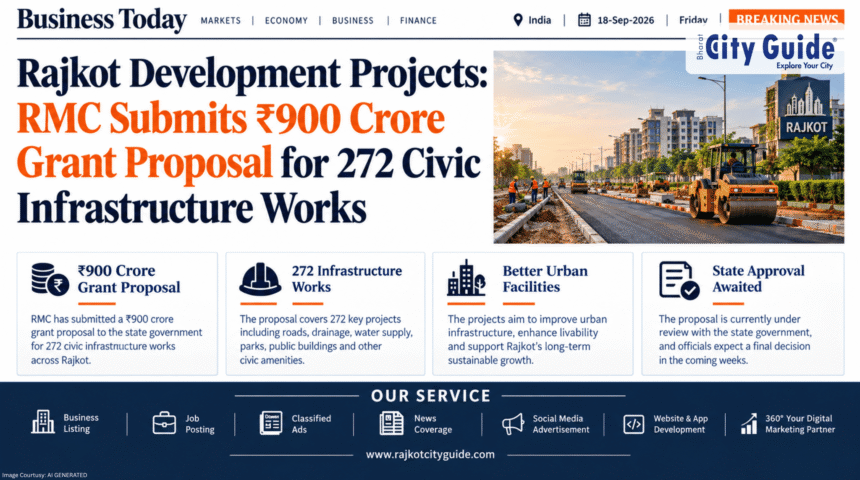
In a major initiative aimed at transforming urban infrastructure and public service delivery across Saurashtra’s primary economic center, the Rajkot Municipal Corporation (RMC) has officially submitted a comprehensive grant proposal worth ₹900 crore to the Gujarat State Government. This ambitious submission outlines a strategic roadmap encompassing 272 individual infrastructure and civil works designed to upgrade essential utilities, including drinking water supply networks, underground drainage systems, urban road resurfacing, and municipal stormwater management across all 18 administrative wards of the city.
- Introduction
- What is Rajkot Development Projects?
- Why This News is Important
- Background Information
- Key Highlights
- Detailed Explanation of the Event
- Benefits, Features, and Importance
- How It Impacts People
- Expert Insights and Industry Perspective
- Challenges and Limitations
- Future Outlook
- Frequently Asked Questions (FAQs)
- Conclusion
In tandem with this massive capital expenditure push, civic authorities held a dedicated administrative event to distribute official appointment letters to 119 newly recruited sanitation workers (safai kamdars). By pairing large-scale physical capital investments with key staffing additions in public health and sanitation, the RMC is addressing both structural urban growth and day-to-day municipal operations. As Rajkot continues its expansion as a major industrial, commercial, and educational hub in Gujarat, this double-barreled development package marks a critical step toward sustainable urban modernization.
What is Rajkot Development Projects?
The Rajkot Development Projects initiative represents a systematic capital deployment plan overseen by the Rajkot Municipal Corporation to modernize, expand, and repair public utilities throughout the city’s urban footprint.
+--------------------------------------------------------------------------+
|                  RMC ₹900 CRORE CIVIC INFRASTRUCTURE PLAN                |
+--------------------------------------------------------------------------+
                                     |
    +--------------------------------+--------------------------------+
    |                                |                                |
    v                                v                                v
[ WATER & DRAINAGE NETWORK ]   [ ROAD & TRANSIT UPGRADES ]   [ SANITATION STRENGTHENING ]
- Pipeline replacements        - Asphalt & concrete paving  - Recruitment of 119 staff
- Drainage line expansions     - Junction redesigns         - Equipment & waste collection
- Pumping station moderns      - Stormwater channel repairs - Daily city cleaning ops
These development projects encompass three foundational pillars:
- Water Resources & Supply Infrastructure: Laying new distribution pipelines, replacing legacy connections, and upgrading water treatment facilities to deliver consistent pressure and clean drinking water to rapidly growing residential zones.
- Sanitation & Drainage Operations: Expanding deep underground drainage grids, managing sewage treatment plant capacities, and maintaining stormwater runoff channels to prevent monsoon waterlogging.
- Urban Mobility & Road Networks: Resurfacing major arterial roads, repairing inter-ward connector streets, installing smart streetlighting, and improving pedestrian walkways across commercial corridors.
Why This News is Important
The submission of a ₹900 crore proposal covering 272 civic works carries immense significance for Rajkot’s residential and commercial landscape:
- Eliminating Infrastructure Deficits: Rapid suburban expansion in fringe areas has created a demand gap for basic municipal utilities like piped water and underground sewage lines.
- Proactive State-City Administrative Coordination: Submitting a detailed, itemized proposal to the state government ensures timely financial clearance under state urban development schemes, such as the Swarnim Jayanti Mukhya Mantri Urban Development Scheme.
- Empowering the Sanitation Workforce: Providing formal appointment letters to 119 sanitation workers enhances workforce security while strengthening RMC’s daily solid waste management and sanitation capabilities.
Background Information
Over the past decade, Rajkot has experienced rapid demographic and industrial growth. The inclusion of new peripheral areas within municipal limits and the expansion of industrial clusters along the Metoda, Aji, and Shapar-Veraval belts have significantly increased the burden on existing civic infrastructure.
During heavy monsoon seasons or periods of peak summer water demand, aging municipal networks have faced operational strain. Water pipeline leakages, localized drainage backflows, and pavement degradation have routinely required municipal attention. Recognizing that piecemeal maintenance is insufficient for a growing population exceeding 20 lakh residents, RMC administrative leadership prepared a master proposal consolidating 272 priority projects into a single ₹900 crore funding requisition submitted directly to state urban development authorities.
Key Highlights
- ₹900 Crore Financial Proposal: Formal grant proposal submitted to the Gujarat State Government for capital infrastructure projects.
- 272 Itemized Civic Works: Encompasses water supply pipelines, underground drainage networks, road repairs, and public facility upgrades.
- Citywide Coverage: Projects span all 18 municipal wards, prioritizing both established core urban areas and newly merged peripheral sectors.
- 119 Appointment Letters Issued: Official recruitment letters handed over to newly appointed sanitation workers (safai kamdars).
- Dual Administrative Focus: Combines long-term physical infrastructure development with immediate workforce expansion in public sanitation.
Detailed Explanation of the Event
The announcement highlights a dual-track effort by the Rajkot Municipal Corporation to address both capital-intensive infrastructure and human resource needs.
[Urban Expansion & Demand] ➔ [RMC Drafts 272 Projects Plan] ➔ [₹900 Cr Grant Proposal Sent] ➔ [State Approval & Execution]
Under the administrative leadership of the Municipal Commissioner and senior civic engineers, RMC compiled detailed project reports (DPRs) for 272 distinct civil projects. These include replacing outdated water pipelines in older city wards, constructing new storm-water drainage channels along flood-prone corridors, and resurfacing high-traffic roadways. The consolidated ₹900 crore proposal was submitted to the state government to secure state funding allocations.
In parallel, RMC hosted an official distribution event where civic leaders and administrative officers presented appointment letters to 119 sanitation workers. This recruitment drive addresses staffing shortages in the solid waste management department, ensuring that daily doorstep waste collection, street sweeping, and public hygiene enforcement keep pace with the city’s expanding geographic limits.
Benefits, Features, and Importance
1. Robust Potable Water Distribution
Upgrading pipeline networks reduces transit losses and ensures equitable water distribution, eliminating localized supply disruptions across residential societies.
2. Modernized Underground Drainage
Expanding sewage networks and stormwater channels helps prevent overflow during monsoon periods, protecting public health and reducing vector-borne disease risks.
3. Smoother Commutes and Reduced Transit Costs
Resurfacing major road corridors lowers vehicle maintenance expenses for commuters, reduces traffic bottlenecks, and supports seamless commercial transport throughout Rajkot.
How It Impacts People
| Stakeholder Category | Direct Impact & Event Benefit |
| Urban Residents | Access to reliable piped water, cleaner streets, and improved drainage infrastructure. |
| Sanitation Workers | Job security, formal municipal employment benefits, and structured duty allocations for 119 families. |
| Local Businesses & Retailers | Improved road conditions and better sanitation near market hubs, boosting retail footfall. |
| Real Estate & Builders | Elevated property values in peripheral wards due to confirmed municipal water and drainage connections. |
Expert Insights and Industry Perspective
Urban planning experts highlight that sustainable municipal growth relies on maintaining a balanced ratio between capital expenditure on heavy civil structures and operational expenditure on daily service maintenance.
By pairing a ₹900 crore grant application for major works with immediate personnel induction in sanitation, RMC demonstrates a dual focus on long-term assets and short-term service delivery. Experts note that securing state grants through detailed project reports accelerates project commencement and minimizes municipal debt.
Challenges and Limitations
To translate this proposal into visible ground-level results, RMC must navigate several administrative and technical considerations:
- Grant Sanction Timelines: Processing and disbursing a ₹900 crore state allocation requires multi-stage administrative approvals.
- Project Execution & Disruption Management: Executing 272 civil works simultaneously across 18 wards will require careful traffic management and utility coordination to minimize public inconvenience.
- Quality Control & Oversight: Strict supervisory auditing will be required to ensure that contractors execute road, water, and drainage works within stipulated timeframes and technical standards.
Future Outlook
Once the state government approves the grant proposal, RMC will initiate competitive bidding and tender evaluations for the 272 projects. Construction activities are expected to roll out in phases across all 18 wards over the coming months.
Combined with the active deployment of the 119 newly appointed sanitation workers, Rajkot’s municipal infrastructure is set for significant operational improvements, paving the way for a cleaner, better-connected, and more resilient urban environment.
Frequently Asked Questions (FAQs)
What is the total budget requested in the new Rajkot Development Projects proposal?
RMC has submitted a grant proposal worth ₹900 crore to the Gujarat State Government.
How many individual infrastructure works are covered under this proposal?
The proposal covers 272 specific civic works distributed across all 18 municipal wards of Rajkot.
What are the main types of civic works included in the proposal?
Key focus areas include water supply pipeline replacements, underground drainage system expansions, road resurfacing, stormwater management, and public utility upgrades.
How many sanitation workers received appointment letters?
Official appointment letters were distributed to 119 newly recruited sanitation workers (safai kamdars).
Which government body will fund these development works?
The proposal has been submitted to the Gujarat State Government for financial clearance under state urban development schemes.
How will these projects benefit residents in peripheral wards?
Peripheral areas will receive new piped drinking water connections, integrated underground drainage lines, and paved connector roads, bringing their civic infrastructure up to central city standards.
Conclusion
The submission of the ₹900 crore grant proposal for 272 Rajkot Development Projects, alongside the induction of 119 sanitation workers, reflects a comprehensive approach to urban governance by the Rajkot Municipal Corporation. By addressing foundational needs in water supply, drainage, road connectivity, and solid waste management, RMC is establishing a strong framework for the city’s future growth. As state approvals move forward, these initiatives will deliver cleaner, safer, and more efficient civic infrastructure to citizens across Rajkot.