Introduction
Maintaining public order, optimizing law enforcement efficiency, and strengthening crime prevention strategies require periodic structural adjustments within police departments. Administrative transfers serve as a fundamental mechanism for law enforcement agencies to realign personnel, prevent localized complacency, and optimize operational performance across urban police stations. In Rajkot—one of Gujarat’s largest urban and commercial centers—police administration periodically undertakes internal reshuffles to ensure agile policing and robust public safety.
- Introduction
- What are Rajkot Police Transfers?
- Why This News is Important
- Background Information
- Key Highlights
- Detailed Explanation of the Event
- Benefits and Importance of Periodic Police Reshuffles
- How It Impacts Different Stakeholders
- Expert Insights and Administrative Perspective
- Challenges and Operational Considerations
- Future Outlook
- Frequently Asked Questions (FAQs)
- Conclusion
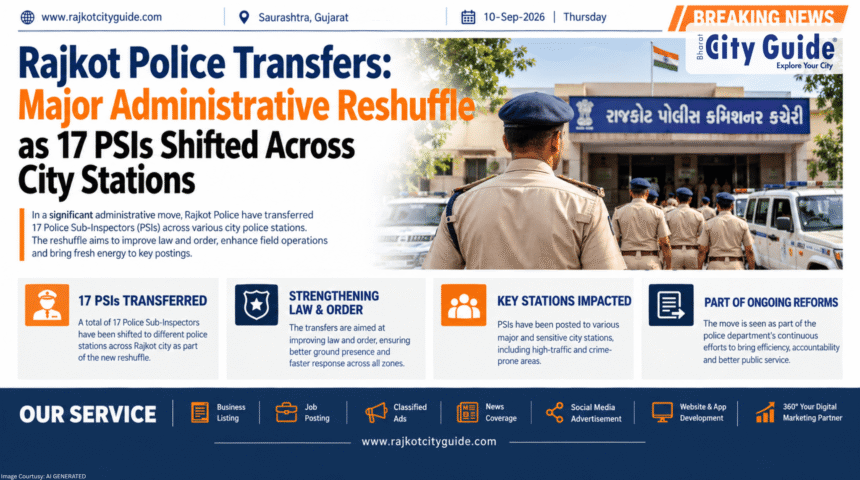
In a significant administrative decision, the Rajkot City Police Commissionerate issued an official transfer order effecting internal shifts for 17 Police Sub-Inspectors (PSIs) simultaneously. Among the prominent moves, PSI P.G. Aalan has been transferred to the prosecution department. This sweeping operational realignment reflects the leadership’s focus on recalibrating ground-level policing, streamlining investigation divisions, and enhancing specialized postings across crime, traffic, and station-level jurisdictions.
This major operational update under the Rajkot Police Transfers framework signals broader administrative movements within the city’s law enforcement structure. With official sources indicating that additional personnel transfer lists will be released in the coming days, this internal reshuffle highlights the ongoing efforts by police leadership to optimize staff deployment and maintain proactive governance across Rajkot.
What are Rajkot Police Transfers?
Rajkot Police Transfers refer to official administrative reassignments of law enforcement personnel across different police stations, branches, specialized cells, and operational wings within the Rajkot City Police Commissionerate jurisdiction.
Conducted under the direction of the Police Commissioner and senior executive officers, these transfers involve shifting officers across various ranks—including Police Sub-Inspectors (PSIs), Police Inspectors (PIs), Assistant Commissioners of Police (ACPs), and constable cadres.
+--------------------------------------------------------------------------+
|                  RAJKOT POLICE ADMINISTRATIVE STRUCTURE                  |
+--------------------------------------------------------------------------+
                                     |
    +--------------------------------+--------------------------------+
    |                                |                                |
    v                                v                                v
[ EXECUTIVE LEADERSHIP ]     [ SPECIALIZED UNITS ]       [ LAW & ORDER STATIONS ]
- Police Commissioner        - Crime Branch & SOG        - Executive Police Stations
- Joint / Addl / Deputy CPs  - Traffic & Prosecution     - Field PSI Deployments
Internal police transfers serve several functional objectives:
- Operational Rotation: Preventing long-tenure stagnation at a single police station to ensure impartial law enforcement.
- Specialized Deployment: Matching individual officer expertise with specific departmental requirements, such as moving experienced investigators to prosecution or specialized crime wings.
- Administrative Discipline: Addressing performance evaluations, vacancy adjustments, and organizational balancing across urban zones.
Why This News is Important
The simultaneous reassignment of 17 PSIs carries significant administrative weight for Rajkot’s law enforcement apparatus:
1. Strengthening Station-Level Governance
PSIs serve as frontline operational leaders in local police stations. They directly oversee investigation files, manage field patrols, and handle public grievances. Realigning 17 PSIs injects fresh operational energy into key urban stations.
2. Streamlining Legal and Prosecution Capabilities
Moving experienced officers like PSI P.G. Aalan to the prosecution branch demonstrates a deliberate effort to strengthen legal documentation, charge-sheet preparation, and courtroom coordination.
3. Precursor to Larger Organizational Realignment
Official indications that further transfer lists will be issued shortly suggest that the current 17-PSI movement is part of a comprehensive restructuring across Rajkot’s entire police framework.
Background Information
Police forces across Gujarat follow established service protocols regarding officer tenures, field rotations, and specialized assignments. In urban commissionerates like Rajkot, maintaining a balanced mix of seasoned investigators and active field personnel across all divisions is essential for managing crime rates and traffic flow.
[ Routine Administrative Review / Performance Audit ]
                          |
                          v
[ Identification of Vacancies & Specialized Branch Needs ]
                          |
                          v
[ Release of PSI Transfer Orders (17 Officers Shifted) ]
                          |
                          v
[ Phased Issuance of Subsequent Staff Transfer Lists ]
Over recent years, Rajkot has experienced rapid demographic and industrial expansion, expanding the operational scope for city police stations. Managing crime prevention, cybercrime investigations, traffic control, and public order requires periodic administrative realignments. Transfers are executed following performance audits, tenure completions, and strategic assessments by senior leadership.
Key Highlights
- Mass Transfer Drive: A total of 17 Police Sub-Inspectors (PSIs) have been transferred simultaneously within the Rajkot City Police Commissionerate.
- Prosecution Reassignment: PSI P.G. Aalan has been officially posted to the Prosecution Department to support legal proceedings and court casework.
- Broad Jurisdiction Cover: Transfers encompass personnel across executive police stations, traffic divisions, crime branches, and specialized units.
- More Transfers Expected: Senior police leadership indicated that additional transfer orders for other departmental personnel will be published in phased lists shortly.
- Operational Focus: The reshuffle aims to boost administrative efficiency, improve case disposal rates, and maintain public order across Rajkot.
Detailed Explanation of the Event
The Rajkot City Police Headquarters formally released the reassignment notification affecting 17 PSIs. Under authority granted by the Police Commissioner, the order reshuffled junior executive leadership across several key jurisdictions.
A major highlight of this order was the strategic movement of PSI P.G. Aalan from field duty to the prosecution wing. The prosecution wing plays a vital role in liaising between police investigators and judicial courts, ensuring that case diaries, evidence chains, and charge-sheets meet legal standards to secure convictions.
+--------------------------------------------------------------------------+
|                  SUMMARY OF PSI REASSIGNMENT OBJECTIVES                  |
+--------------------------------------------------------------------------+
| Operational Domain     | Strategic Objective                             |
+------------------------+-------------------------------------------------+
| Local Police Stations  | Refresh leadership and boost field patrols       |
| Prosecution Division   | Expedite court filings and legal case processing |
| Traffic & Crime Units  | Enhance specialized monitoring and enforcement  |
+------------------------+-------------------------------------------------+
The administrative circular instructed all 17 officers to hand over their current charges and report to their newly designated stations immediately. Departmental sources confirmed that this reshuffle serves as the first phase of a broader administrative recalibration, with further transfer lists covering additional police personnel expected soon.
Benefits and Importance of Periodic Police Reshuffles
Implementing systematic Rajkot Police Transfers provides long-term operational advantages for municipal police administration:
1. Eliminating Local Inertia
Routine rotations prevent officers from developing familiarities that could compromise impartial enforcement, helping maintain public trust.
2. Cross-Training and Skill Diversification
Exposing officers to varied duties—such as moving between field stations, traffic management, and prosecution wings—builds a well-rounded police force skilled in all aspects of law enforcement.
3. Rapid Case Disposal and Legal Accountability
Strengthening specialized wings like prosecution speeds up trial preparation and legal documentation, improving conviction rates for pending cases.
4. Optimized Resource Allocation
Periodic transfers allow leadership to deploy experienced officers to high-density or crime-sensitive areas according to current operational needs.
How It Impacts Different Stakeholders
| Stakeholder Group | Direct Impact & Key Outcomes |
| General Public & Citizens | Improved responsiveness at local police stations and refreshed field supervision. |
| Law Enforcement Personnel | New operational responsibilities, skill diversification, and exposure to different urban zones. |
| Judiciary & Legal System | Smoother trial coordination and faster document processing from the newly strengthened prosecution wing. |
| City Administration | Streamlined public order enforcement and better coordination across police zones. |
Expert Insights and Administrative Perspective
Public administration experts and retired senior police officials view routine internal transfers as an essential health check for urban law enforcement agencies.
“Internal transfers within urban police commissionerates are crucial for maintaining operational sharpness. Shifting personnel across stations prevents administrative stagnation, balances workloads, and places the right talent in critical positions like prosecution and crime investigation. When executed systematically, these reshuffles strengthen public safety and improve internal discipline.”
Former enforcement officials also note that transferring capable personnel to prosecution divisions resolves a common bottleneck in the criminal justice chain, ensuring that police investigations lead to successful courtroom convictions.
Challenges and Operational Considerations
Executing large-scale administrative transfers presents several practical challenges:
- Transition Time and Handover Delays: Incoming officers require time to familiarize themselves with local crime trends, ongoing investigation files, and neighborhood dynamics.
- Maintaining Investigation Continuity: Transfers must be managed carefully to ensure that active criminal investigations do not suffer delays during charge handovers.
- Administrative Adaptation: Shifted officers must quickly build working relationships with new station teams, community leaders, and local civic authorities.
Future Outlook
Following the reassignment of 17 PSIs, additional administrative shifts are anticipated within the Rajkot Police Commissionerate:
- Subsequent Transfer Lists: Official notifications covering additional police constables, head constables, and senior inspectors are expected shortly.
- Performance Monitoring: Senior leadership will evaluate the operational impact of new station assignments over the coming months to ensure improved case resolution times.
- Tech-Driven Policing: Newly posted station officers are expected to drive digital initiatives, including e-FIR processing, CCTV surveillance expansion, and online grievance tracking.
Frequently Asked Questions (FAQs)
1. How many officers were affected in the recent Rajkot police transfer order?
A total of 17 Police Sub-Inspectors (PSIs) were transferred simultaneously within the Rajkot City Police Commissionerate.
2. Where was PSI P.G. Aalan transferred?
PSI P.G. Aalan was reassigned from his current posting to the Prosecution Department within the police administrative structure.
3. What is the purpose of transferring officers to the prosecution wing?
Transferring experienced officers to the prosecution wing strengthens legal documentation, improves case presentation in court, and speeds up trial proceedings.
4. Are more police transfers expected in Rajkot soon?
Yes, police department sources indicated that additional transfer lists covering other police staff and ranks will be issued in upcoming phases.
5. Who authorizes internal PSI transfers within Rajkot city?
Internal transfers within the city jurisdiction are issued under the authority of the Rajkot City Police Commissioner and senior administrative boards.
6. How often do police transfers occur in Gujarat cities?
Internal police transfers occur periodically based on tenure completion, administrative reviews, routine rotations, or strategic operational adjustments.
7. How do these transfers benefit the general public in Rajkot?
Transfers help maintain administrative transparency, improve police responsiveness, prevent local stagnation, and ensure efficient handling of public complaints across city stations.
Conclusion
The recent Rajkot Police Transfers involving 17 PSIs reflect a proactive approach to city law enforcement management. By strategically reassigning officers across police stations and moving experienced personnel like PSI P.G. Aalan to the prosecution division, police leadership is working to enhance operational efficiency, speed up legal proceedings, and strengthen public safety.
As additional transfer lists are released in the coming days, this administrative realignment will help build a more responsive, efficient, and community-focused police force across Rajkot.