Introduction
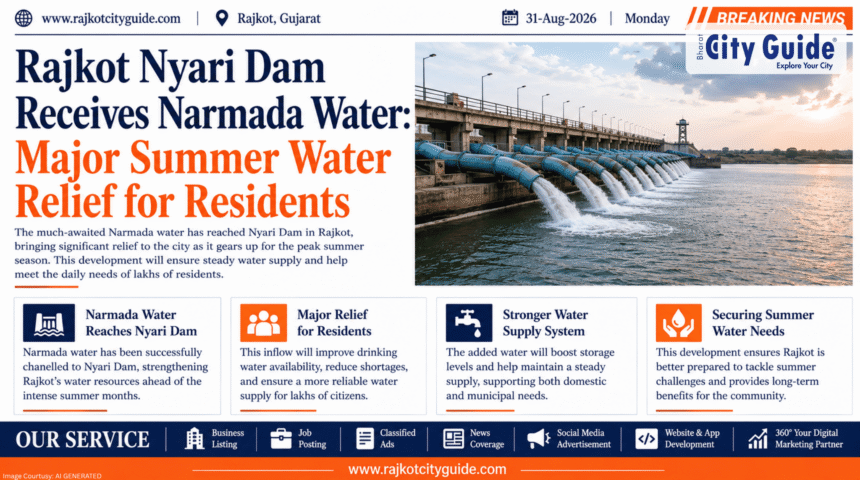
In a major development that brings immense relief to thousands of households across Saurashtra’s economic hub, Rajkot Nyari Dam Receives Narmada Water under the flagship Saurashtra Narmada Avtaran Irrigation (SAUNI) Yojana. The Irrigation Department, in coordination with the Rajkot Municipal Corporation (RMC), has officially initiated the pumping of water from the Narmada canal grid into the Nyari-1 reservoir. Furthermore, authorities have confirmed that Narmada water pumping into the Aji-1 Dam will also commence shortly.
- Introduction
- What is Rajkot Nyari Dam Receives Narmada Water?
- Why This News is Important
- Background Information
- Key Highlights
- Detailed Explanation of the Event
- Benefits, Features, and Importance
- How It Impacts People
- Expert Insights / Industry Perspective
- Challenges and Limitations
- Future Outlook
- Frequently Asked Questions (FAQs)
- Conclusion
This timely administrative action arrives as a critical intervention to prevent potential drinking water shortages in Rajkot. Due to erratic monsoon patterns and insufficient natural inflows into local reservoirs earlier, the municipal administration faced the daunting challenge of managing daily water distribution across expanding urban zones. With the release of Narmada water into Nyari-1, the threat of water cuts or reduced distribution pressure has been averted.
As the state irrigation network channels millions of cubic feet of water into Rajkot’s key reservoirs, city officials assure residents that drinking water supplies are fully secured for the upcoming summer months and beyond. This comprehensive update explores the technical mechanisms, administrative efforts, and long-term urban benefits of this critical infrastructure milestone.
What is Rajkot Nyari Dam Receives Narmada Water?
The phrase Rajkot Nyari Dam Receives Narmada Water describes the strategic diversion and pumping of water from the Narmada main canal system into the Nyari-1 Dam, one of the primary drinking water reservoirs serving Rajkot city.
┌─────────────────────────────────────────────────────────────────────────┐
│                     SAUNI YOJANA WATER TRANSFER PIPELINE               │
├─────────────────────────────────────────────────────────────────────────┤
│  Narmada Main Canal Grid                                                │
│  │                                                                      │
│  ▼                                                                      │
│  SAUNI Yojana Link Pipelines & Pumping Stations                         │
│  │                                                                      │
│  ▼                                                                      │
│  Nyari-1 Dam Reservoir  ───►  Aji-1 Dam Reservoir (Commencing Soon)    │
│  │                                                                      │
│  ▼                                                                      │
│  RMC Water Treatment Plants & Urban Distribution Network                 │
└─────────────────────────────────────────────────────────────────────────┘
Operated under the SAUNI Yojana—a massive engineering initiative designed to redirect surplus Narmada floodwaters to drought-prone reservoirs across Saurashtra—this process fills local dams when natural rainfall falls short.
Key components defining this water transfer drive include:
- Primary Target Reservoir: Nyari-1 Dam, which holds a gross storage capacity of approximately 1,248 million cubic feet (MCFT).
- Secondary Target Reservoir: Aji-1 Dam, scheduled to receive Narmada water immediately following the Nyari-1 operational cycle.
- Infrastructure Pipeline: SAUNI Yojana Link-3 and connecting feeder pipelines equipped with heavy-duty pumping stations.
- Inflow Management: High-volume daily discharge into the dam basin to rapidly raise water levels above critical depletion thresholds.
- Governing Authorities: Joint execution by the Gujarat State Irrigation Department and the Rajkot Municipal Corporation (RMC).
Why This News is Important
The arrival of Narmada water at Nyari Dam holds profound social, economic, and administrative significance for Rajkot and the surrounding Saurashtra region:
- Complete Elimination of Water Shortages: Securing steady inflows into Nyari-1 and Aji-1 guarantees that the civic body can maintain regular 20-minute daily tap water supplies without imposing water cuts.
- Protection Against Summer Scarcity: Replenishing reservoirs ensures adequate drinking water reserves to withstand high summer temperatures and evaporation losses.
- Urban Economic Stability: As a major industrial and commercial center for machinery, auto parts, and jewelry, Rajkot relies on a dependable municipal water grid to sustain industrial activities and workforce residential areas.
- Demonstration of Infrastructure Reliability: The active utilization of the SAUNI Yojana pipeline network illustrates the value of long-term state water grid investments during low-rainfall periods.
Background Information
Historically, Rajkot’s rapid urban and industrial expansion created severe pressure on its local water resources. The city traditionally depended on rainfall in the catchment areas of the Aji-1, Nyari-1, and Bhadar reservoirs. However, monsoon precipitation in Saurashtra is notoriously erratic, leading to recurring drought cycles, depleted groundwater tables, and severe municipal water crises during dry years.
To solve Saurashtra’s chronic water deficit, the Government of Gujarat launched the Saurashtra Narmada Avtaran Irrigation (SAUNI) Yojana. Under this mega project, over 1,100 kilometers of high-capacity underground pipelines were laid across four major links to connect 115 existing dams to the Narmada canal network.
When monsoon rains fail to fill local dams to capacity, the Rajkot Municipal Corporation submits formal requests to the State Irrigation Department to release Narmada water. Although minor technical delays briefly paused water intake earlier, prompt follow-ups by civic officials resolved the issues, allowing water transfer into Nyari-1 to resume at full capacity.
Key Highlights
- Active Inflow: Narmada water pumping into Nyari-1 Dam has officially resumed and is actively raising reservoir levels.
- Aji-1 Pipeline Next: Pumping into Aji-1 Dam is set to begin shortly under the SAUNI Yojana framework.
- Zero Water Cuts: The Rajkot Municipal Corporation has assured citizens that no indirect or direct water cuts will be implemented.
- Summer Supply Guaranteed: Sufficient water volumes are being transferred to meet municipal demand through the upcoming summer months.
- Inter-Departmental Coordination: Smooth execution achieved through close cooperation between the State Irrigation Department and RMC engineering teams.
- Addressing Deficits: The initiative compensates for insufficient natural monsoon inflows in local dam catchment areas.
Detailed Explanation of the Event
The resumption of water pumping into Nyari-1 Dam represents a crucial success for Rajkot’s municipal management. Earlier in the season, local rainfall had not generated sufficient runoff to fill Aji-1 and Nyari-1 to their required operational levels. Recognizing the risk of an impending water crisis, RMC requested the state government allocate Narmada water under the SAUNI Yojana to cover the city’s needs through the summer.
                  [ RAJKOT WATER SECURITY WORKFLOW ]
                                   │
  Deficit Natural Inflow ──► RMC Submits SAUNI Request
                                   │
  Irrigation Dept Clears Pipeline ──► Technical Glitch Resolved
                                   │
  Nyari-1 Dam Filled (Active) ──► Aji-1 Dam Pumping (Imminent)
                                   │
  Uninterrupted Daily Municipal Supply Secured
The Irrigation Department promptly initiated water releases. However, an unexpected technical glitch temporarily halted pipeline operations for about a week, raising concerns among local administrators. Without this supply, the civic body would have been forced to lower distribution pressure or enforce indirect water rationing.
RMC leadership followed up closely with state irrigation engineers to resolve the technical bottleneck. Pumping resumed smoothly, and Narmada water is now flowing into Nyari-1 Dam at a steady rate. With Nyari-1 receiving continuous intake, the Irrigation Department is finalizing preparations to open the intake valves for Aji-1 Dam as well, securing both primary drinking water sources for the city.
Benefits, Features, and Importance
The table below summarizes the operational and public benefits resulting from the Narmada water release into Rajkot’s dams:
| Feature / Aspect | Previous Risk / Situation | New Status With Narmada Water | Direct Benefit to Rajkot |
|---|---|---|---|
| Nyari-1 Water Level | Depleting rapidly; insufficient monsoon storage. | Continuous high-volume intake under SAUNI Yojana. | Restores reservoir storage to optimal operational capacity. |
| Aji-1 Water Level | Below ideal summer reserve levels. | Pumping operations commencing shortly. | Secures secondary source for eastern municipal zones. |
| Municipal Supply Schedule | Threat of water cuts or low distribution pressure. | Guaranteed regular daily distribution. | Ensures hassle-free tap water access for households. |
| Summer Resilience | High vulnerability to drought and heatwave evaporation. | Water reserves locked in through summer. | Eliminates the need for emergency water tankers. |
| Public Peace of Mind | Anxiety over impending water rationing. | Complete relief for urban residents. | Restores confidence in public utility services. |
How It Impacts People
For Citizens and Households
For the residents of Rajkot, the news brings immediate relief. Families can rely on predictable daily municipal water distribution without worrying about emergency storage tanks, private water tanker expenses, or altered daily routines.
For Municipal and Civic Authorities
The replenishment of Nyari-1 alleviates administrative pressure on the Rajkot Municipal Corporation. Instead of managing crisis mitigation, public complaints, and rationing logistics, RMC engineers can focus on routine maintenance, filtration quality, and pipeline upgrades across newly merged urban areas.
For Commercial and Small-Scale Industries
Local commercial establishments, textile units, engineering workshops, and small businesses rely on stable urban infrastructure. Securing the city’s primary water reservoirs prevents secondary economic disruptions and operational cost hikes associated with water scarcity.
Expert Insights / Industry Perspective
Water management experts and civil engineers highlight the SAUNI Yojana’s role as a vital safety net for urban centers in semi-arid regions.
Infrastructure analysts observe that connecting coastal and inland dams to the statewide Narmada grid transforms static local reservoirs into active, regulated storage nodes. When localized rainfall fails, the bulk water grid steps in to compensate.
Environmental engineers also note that maintaining healthy water levels in Nyari-1 and Aji-1 throughout the year helps recharge localized groundwater aquifers around Rajkot, reducing salinity and improving surrounding tubewell yields.
Challenges and Limitations
While the release of Narmada water resolves immediate scarcity risks, long-term urban water management faces ongoing operational considerations:
- Energy and Pumping Costs: Transporting bulk water across long distances through underground SAUNI pipelines involves high electricity consumption and continuous maintenance costs.
- Technical Pipeline Vulnerabilities: As shown by the recent brief stoppage, mechanical failures, pipe bursts, or electrical pump issues can temporarily disrupt intake schedules.
- Urban Growth Demands: Rapid expansion and the merging of outer villages into Rajkot Municipal Corporation (RMC) limits continuously push daily water demand higher, requiring expanding distribution grids.
Future Outlook
The outlook for Rajkot’s water infrastructure remains highly positive as state and civic authorities continue to refine bulk distribution systems:
- Dual-Dam Coverage: With Aji-1 set to join Nyari-1 in receiving Narmada water, the city will achieve balanced water distribution across both its western and eastern municipal zones.
- Smart Grid Monitoring: The Irrigation Department is progressively deploying automated flow meters and SCADA systems along SAUNI pipelines to detect technical issues early and prevent supply interruptions.
- Long-Term Water Security: Continued integration between state canal grids and local reservoirs ensures Rajkot can support its growing population and industrial economy without suffering recurring seasonal droughts.
Frequently Asked Questions (FAQs)
1. What is the current status of Narmada water inflow into Nyari Dam?
Narmada water pumping into the Nyari-1 Dam has officially resumed and is actively refilling the reservoir under the SAUNI Yojana.
2. Is Narmada water also being released into Aji Dam?
Yes, the Irrigation Department is completing technical preparations to start pumping Narmada water into Aji-1 Dam shortly.
3. Will Rajkot residents face any water cuts this summer?
No, the Rajkot Municipal Corporation has assured citizens that drinking water supplies are fully secured, eliminating the need for water cuts or pressure reductions.
4. What caused the brief delay in Narmada water delivery earlier?
Water delivery was briefly paused for about a week due to minor technical issues along the pipeline network, which were promptly resolved by irrigation engineers.
5. What is the SAUNI Yojana, and how does it help Rajkot?
The SAUNI Yojana is a state engineering project that channels surplus Narmada floodwaters through underground pipelines to fill 115 dams across Saurashtra, securing drinking and irrigation supplies during dry periods.
6. Which local municipal sources supply drinking water to Rajkot?
Rajkot’s primary drinking water sources are the Nyari-1, Aji-1, and Bhadar reservoirs, supported by Narmada canal transfers.
7. How does this development benefit the city’s long-term planning?
Securing water storage in local dams allows the municipal corporation to focus on distribution pipeline expansion, urban infrastructure, and long-term economic development without crisis management distractions.
Conclusion
The announcement that Rajkot Nyari Dam Receives Narmada Water marks a major victory for civic planning and proactive governance in Saurashtra. By leveraging the SAUNI Yojana pipeline network to refill Nyari-1 and soon Aji-1 Dam, state and municipal authorities have successfully protected the city from potential water shortages. This swift intervention guarantees reliable daily drinking water for households, supports local commercial activities, and ensures Rajkot can enter the summer months with full water security.