Introduction
As the seasonal rains roll across Gujarat, bringing a welcome respite from the scorching summer heat, they also bring an unavoidable surge in public health challenges. Accumulating rainwater, shifting humidity levels, and sudden drops in temperature create the perfect breeding environment for dangerous disease-causing vectors and water-borne pathogens. Acknowledging these seasonal threats, the Rajkot Municipal Corporation (RMC) has taken a massive leap forward by implementing a comprehensive and rigorous Monsoon Health Action Plan. Designed to address the sudden spike in vector-borne and water-borne ailments, this structural action plan ensures that the city’s health machinery remains fully operational and highly responsive even under intense crisis conditions.
- Introduction
- What is a Monsoon Health Action Plan?
- Why This News is Important
- Background Information
- Key Highlights
- Detailed Explanation of the Event
- Benefits and Importance of the Action Plan
- How It Impacts People
- Expert Insights and Industry Perspective
- Challenges and Limitations
- Future Outlook
- Frequently Asked Questions (FAQs)
- Conclusion
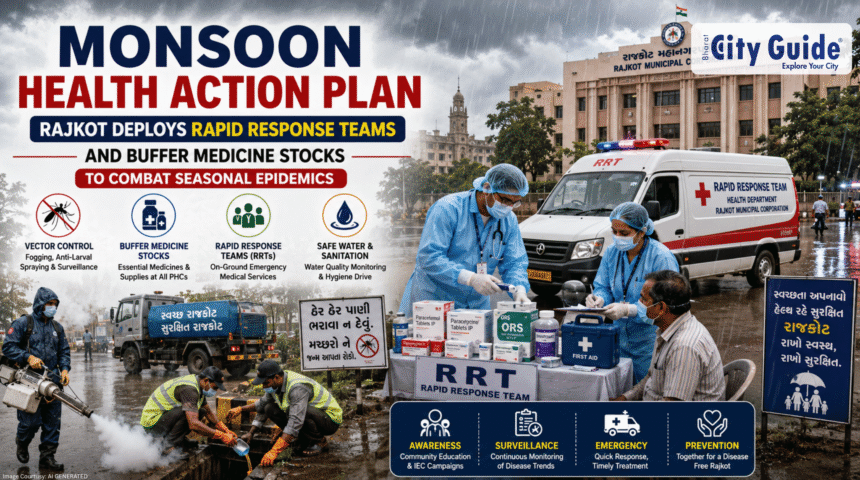
The announcement of this strategic blueprint underlines the administrative agility required to safeguard urban populations during the rainy months. Local health centers are now equipped with massive buffer stocks of essential medications, ensuring that vulnerable communities face no shortages when seasonal outbreaks hit. More importantly, the RMC’s health department has initialized the deployment of dedicated Rapid Response Teams (RRTs) to provide on-the-ground emergency medical services at a moment’s notice.
Understanding this proactive model is crucial, not just for the residents of Rajkot, but for public health administrators nationwide. Effective monsoon epidemic control demands highly coordinated, preventive, and curative measures. By evaluating Rajkot’s detailed healthcare blueprint, this extensive article uncovers how the civic body plans to mitigate vector-borne threats like dengue, malaria, and chikungunya, alongside classic water-borne vulnerabilities like cholera and gastroenteritis, ensuring public safety throughout the season.
What is a Monsoon Health Action Plan?
A Monsoon Health Action Plan is an integrated, multi-layered healthcare strategy executed by municipal administrations and public health departments to prevent, control, and treat seasonal disease outbreaks triggered by heavy rainfall. The onset of the monsoon season alters environmental dynamics drastically, opening up opportunities for viruses, bacteria, and parasites to proliferate. Consequently, a standalone healthcare routine is highly inadequate, necessitating an adaptive, accelerated plan of action.
This specialized operational framework integrates several distinct segments of civic administration:
- Preventive Healthcare: Continuous vector surveillance, anti-larval spraying, fogging operations, and mass awareness programs.
- Curative Healthcare: Establishing deep reserves or buffer stocks of broad-spectrum antibiotics, anti-malarial drugs, ORS packets, analgesics, and essential IV fluids across primary health clinics.
- Emergency Response: Mobilizing highly mobile medical professionals—organized into Rapid Response Teams—capable of reaching hotspots to isolate, diagnose, and treat clusters of infection before they morph into widespread epidemics.
- Inter-Departmental Coordination: Aligning health workers with water sewage management, waste disposal teams, and local municipal corporations to clear clogging and eliminate stagnancy immediately.
Ultimately, this structural mechanism shifts a city’s healthcare posture from passive treatment to highly dynamic, defensive prevention.
Why This News is Important
The rollout of Rajkot’s Monsoon Health Action Plan serves as a vital indicator of modernized, preemptive urban disaster management. Historically, public health systems across developing nations have operated reactively—scrambling to allocate resources only after local hospitals are overwhelmed with patients suffering from dengue or water-borne diarrhea. This action plan changes the narrative entirely by treating the monsoon not just as a weather pattern, but as a predictable public health emergency requiring upfront investment.
By setting up buffer stocks of medical supplies well in advance, the administration successfully insulates the healthcare supply chain against panic buying, price hikes, or unexpected logistical disruptions caused by urban flooding. Furthermore, the positioning of Rapid Response Teams ensures that localized transmission chains are broken instantly. When a case of vector-borne illness is detected, these teams step in to screen neighbors, eliminate nearby vector breeding sources, and administer immediate medical aid, preventing localized cases from evolving into a full-blown community crisis.
Background Information
Rajkot, a vital economic and industrial hub within Gujarat, features an expanding urban landscape with high-density residential areas, industrial clusters, and developing suburbs. During heavy monsoon spells, specific low-lying pockets, construction sites, and congested neighborhoods routinely experience micro-flooding and persistent waterlogging. Historically, these environmental changes have correlated directly with cyclical spikes in seasonal illnesses.
In recent years, cities across western India have seen an erratic shift in monsoon distributions, characterized by short, extremely intense bursts of downpour followed by prolonged dry, humid spells. Public health experts observe that these exact conditions are highly conducive to the breeding cycles of the Aedes aegypti mosquito (the primary carrier of dengue and Zika viruses), which thrives in clean, stagnant water accumulating in household items, tires, and pots during dry breaks. Additionally, heavy rain frequently tests local drainage infrastructure, occasionally leading to sub-surface cross-contamination between sewage lines and municipal drinking water pipelines.
Recognizing these historical trends and evolving weather dynamics, the RMC health branch realized that the traditional, standard operating procedures were insufficient. The creation of a dedicated, data-driven monsoon contingency model became an absolute necessity to prevent local clinics from buckling under the strain of seasonal patient surges.
Key Highlights
The Rajkot Municipal Corporation’s updated emergency healthcare strategy includes the following primary components:
- Establishment of Robust Buffer Stocks: Comprehensive accumulation of seasonal medications, testing kits, and rehydration salts across all primary health centers (PHCs) and community health centers.
- Activation of Rapid Response Teams (RRTs): Dedicated emergency teams consisting of doctors, paramedical staff, and laboratory technicians on standby for instant field deployment.
- Targeted Vector Control Operations: Intensified anti-larval treatments, source reduction campaigns, and indoor/outdoor fogging in historically vulnerable zones.
- Drinking Water Quality Surveillance: Enhanced routine chlorination monitoring and daily water sample collections to completely eliminate the risk of water-borne pathogens.
- Focus on Localized Hotspots: Utilizing historical health data to identify vulnerable wards, allowing for concentrated deployment of municipal sanitization assets.
Detailed Explanation of the Event
According to the official developments reported by the Rajkot Municipal Corporation’s health branch, a high-level operational review was executed to establish an airtight defense against seasonal diseases. The foundational pillar of this year’s execution is the mandatory creation of a “medicine buffer stock” across all civic-run healthcare centers. This policy guarantees that regardless of external conditions, every single municipal clinic will remain stocked with vital antipyretics, anti-malarial treatments, heavy-duty antibiotics, skin ointments, and life-saving intravenous fluids.
Concurrently, the health branch has formalized the operational mandate for its emergency service squads: the Rapid Response Teams. These units act as the frontline infantry of the Monsoon Health Action Plan. Rather than waiting for critically ill patients to navigate flooded streets to reach a hospital, these RRTs are dispatched directly into communities that show early signs of disease clustering. Equipped with diagnostic toolkits for rapid dengue and malaria testing, these teams perform on-the-spot assessments, isolate infected individuals, and distribute preventive medications to surrounding households.
On the environmental front, the Rajkot Municipal Corporation (RMC) has synchronized its health inspectors with sanitation teams. They are actively penalizing open-air scrap yards, construction sites, and commercial complexes that fail to clear stagnant water accumulations. Simultaneously, massive public health drives are being organized to educate citizens on the “Dry Day” concept—encouraging families to completely drain and scrub clean all home water coolers, flower vases, and storage barrels once a week to disrupt the mosquito breeding cycle.
Benefits and Importance of the Action Plan
The systematic deployment of this comprehensive plan offers multi-faceted structural benefits to the city’s complex socioeconomic framework:
1. Relief for Tertiary Healthcare Infrastructure
By screening, diagnosing, and treating the vast majority of mild-to-moderate seasonal illnesses at the primary health center level through buffer stocks, large civil hospitals are protected from sudden overcrowding. This allows major emergency rooms to keep their beds open for critical, non-seasonal medical emergencies.
2. Drastic Reduction in Mortality Rates
Vector-borne conditions like dengue hemorrhagic fever can escalate from mild fever to internal complications rapidly if left unchecked. Early detection by mobile Rapid Response Teams guarantees that high-risk individuals are routed to intensive monitoring early, significantly decreasing mortality figures.
3. Economic Stability for Vulnerable Groups
Out-of-pocket medical expenditure during seasonal health crises can devastate low-income families. By offering completely free diagnostic tests, consultations, and medications through fully stocked local public clinics, the RMC lifts a massive economic burden off its working-class citizens.
4. Data-Driven Long-Term Urban Planning
The data gathered by RRTs regarding active infection hotspots provides the municipality with precise geographical maps of where infrastructural vulnerabilities lie. These data points guide post-monsoon drainage overhauls and water pipeline replacements.
How It Impacts People
The successful implementation of the Monsoon Health Action Plan leaves a direct, positive footprint on various segments of Rajkot’s population:
- General Citizens and Daily Wage Earners: For individuals dependent on daily physical labor, a prolonged bout of malaria or typhoid translates directly to lost wages and financial distress. Safe public drinking water and immediate localized healthcare keep the workforce healthy and economically secure.
- Children and School Students: Schools often become hubs for rapid viral transmission during the monsoons. The targeted anti-larval spraying and vector control surrounding educational campuses protect young children who are uniquely vulnerable to severe complications from vector-borne illnesses.
- Elderly and Immunocompromised Populations: Senior citizens living with preexisting conditions face severe threats from water-borne infections like gastroenteritis. The assurance of accessible primary health facilities equipped with authentic buffer stocks offers them a critical safety net.
Expert Insights and Industry Perspective
Epidemiologists and public health specialists globally have long asserted that climate change is actively rewriting the rules of seasonal disease management. The traditional approach of launching anti-mosquito campaigns only after the arrival of rains is no longer sufficient due to highly erratic precipitation schedules.
Modern healthcare research strongly supports the preemptive accumulation of decentralized medical supplies. According to public health experts, deploying mobile units like Rapid Response Teams yields a much higher return on investment than expanding hospital wards after an outbreak. When field teams actively intercept a vector pocket early, they effectively prevent hundreds of secondary infections, proving that smart logistics and field mobility are the defining elements of modern urban epidemiology.
Challenges and Limitations
Despite the stellar design of the Monsoon Health Action Plan, its execution is bound to face real-world operational bottlenecks:
- Public Apathy and Resistance: Civic bodies frequently struggle with domestic non-compliance. Health workers often report that residents refuse to let municipal teams enter their private properties for vector inspections or to clear hidden stagnant pools in balconies and courtyards.
- Extreme Weather Disruptions: If Rajkot faces unexpected flash floods, physical accessibility to waterlogged slums can become severely impaired. This can temporarily restrict the movement of Rapid Response Teams, leaving isolated clusters vulnerable.
- Labor Shortages: Maintaining round-the-clock surveillance, operating heavy fogging machinery, and running diagnostic clinics simultaneously demands huge numbers of trained paramedical personnel, which can stretch the municipal workforce to its limits during extended monsoon seasons.
Future Outlook
Looking forward, the integration of technology will undoubtedly redefine how municipal systems execute their health strategies. Future variants of the Monsoon Health Action Plan will likely move away from manual reporting, adopting predictive artificial intelligence and geographic information system (GIS) mapping models instead. By evaluating real-time rainfall distributions, satellite humidity tracking, and localized clogged drain alerts, algorithms will soon be able to forecast precisely which municipal wards will experience a dengue flare-up two weeks before it happens.
Additionally, reinforcing civic infrastructure—such as completely segregating drinking water conduits from drainage networks and introducing underground rainwater harvesting systems—will fundamentally reduce vector breeding landscapes. Until these long-term infrastructural goals are fully realized, proactive initiatives like Rajkot’s current action plan remain the definitive standard for urban health security.
Frequently Asked Questions (FAQs)
Q1: What is the primary focus of Rajkot’s Monsoon Health Action Plan?
A: The primary focus is to proactively prevent, manage, and eliminate outbreaks of seasonal vector-borne diseases (like dengue, malaria, and chikungunya) and water-borne illnesses (like cholera and typhoid) through decentralized medicine buffer stocks and emergency Rapid Response Teams.
Q2: How do Rapid Response Teams (RRTs) function during the monsoon?
A: RRTs are mobile emergency medical squads comprising doctors, nurses, and lab technicians. They are deployed directly to areas reporting clusters of illness to conduct on-the-spot testing, administer early treatment, and eliminate local contamination sources.
Q3: What items are included in the municipal medicine buffer stock?
A: The buffer stock includes critical supplies such as broad-spectrum antibiotics, antipyretics (paracetamol), anti-malarial courses, Oral Rehydration Salts (ORS) packets, IV fluids, and specialized rapid diagnostic kits.
Q4: How can citizens contribute to the success of this health plan?
A: Residents must participate by observing a weekly “Dry Day” to empty standing water around their homes, ensuring municipal inspectors are allowed access for vector tracking, and consuming boiled or chlorinated water.
Q5: Why are vector-borne diseases more prevalent during the rainy season?
A: Persistent rainfall creates pockets of stagnant water in empty containers, potholes, and construction sites. These pools provide the perfect, undisturbed breeding grounds for mosquitoes to deposit eggs and multiply.
Q6: Where can Rajkot residents access the benefits of this plan?
A: The benefits, including free medical evaluations, diagnostic testing, and emergency medications, are directly accessible across all Rajkot Municipal Corporation-administered primary health centers and mobile clinic outposts.
Conclusion
The implementation of the comprehensive Monsoon Health Action Plan by the Rajkot Municipal Corporation represents a massive step forward in municipal governance and proactive healthcare management. By directly addressing the root causes of monsoon illnesses through aggressive vector tracking, secure medicine buffer stocks, and highly agile Rapid Response Teams, the city demonstrates how modern urban spaces can defend themselves against cyclical health hazards.
Ultimately, defeating seasonal epidemics requires a shared commitment. While the local administration provides the resources, infrastructure, and medical expertise, the structural success of this initiative depends heavily on active citizen compliance and community hygiene awareness. Through this unified approach, Rajkot sets a highly resilient example, ensuring its population remains safe, healthy, and vibrant throughout the rainy season.