Introduction
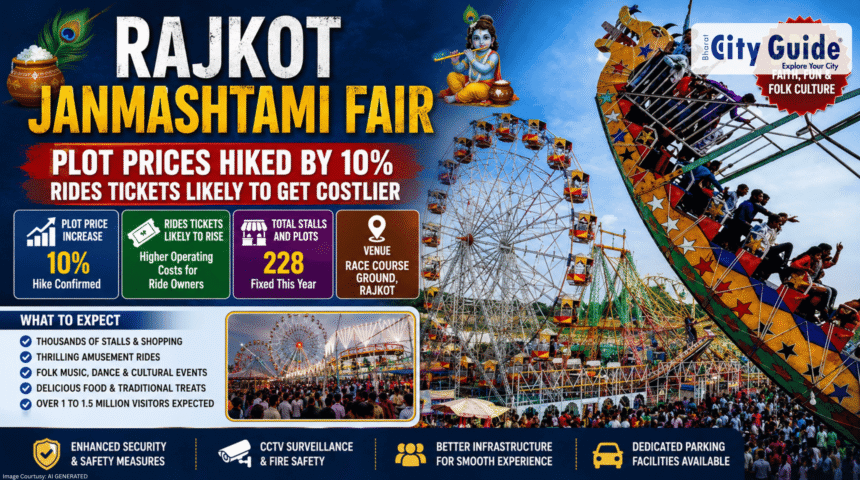
The cultural heart of Gujarat, Saurashtra, is bustling with anticipatory excitement as preparations for the grandest cultural gathering of the region begin. Known for its unparalleled vibrancy, rhythmic folk dances, massive crowds, and iconic giant wheels, the iconic annual carnival is back in the news. However, this year’s announcement brings critical adjustments for vendors and visitors alike. According to recent administration updates regarding the upcoming Rajkot Janmashtami Fair, the district authorities have implemented a 10% hike in the base prices of plot allotments for commercial stalls. This fiscal revision is expected to trigger a domino effect, leading to an increase in amusement ride ticket prices across the fairground.
- Introduction
- What is Rajkot Janmashtami Fair?
- Why This News is Important
- Background Information
- Key Highlights
- Detailed Explanation of the Event
- Benefits and Features of the Fair
- How It Impacts People
- Expert Insights and Industry Perspective
- Challenges and Limitations
- Future Outlook
- Frequently Asked Questions (FAQs)
- Conclusion
For generations, this mega cultural event has served as a cornerstone of community bonding and festive celebration across Western India. Drawing over a million people over its five-day run, the fair merges spiritual devotion with rural commerce and modern entertainment. With the total number of official stalls and plots strictly capped at 228 this year, competition among local merchants and amusement park operators is fiercer than ever. For families planning their annual holiday trip and businesses budgeting their commercial expenditures, understanding these structural and economic changes is highly essential. This extensive coverage provides a comprehensive breakdown of the latest official notifications, financial implications, historical contexts, and operational setups defining the event.
What is Rajkot Janmashtami Fair?
The Rajkot Janmashtami Fair, locally and popularly celebrated as the “Rajkot Lok Mela,” is the single largest public folk festival organized in the Saurashtra region of Gujarat. Held annually at the sprawling Race Course Ground in Rajkot, this traditional mega-fair commemorates the birth anniversary of Lord Krishna. Officially spanning five continuous days—starting from the sixth day of the waning phase of the Shravan month (Shravan Vad Chhath) and concluding on the tenth day (Dasham)—it stands as a monumental cultural symbol for millions of citizens.
Far from being a mere commercial marketplace, the fair serves as a massive platform preserving the region’s indigenous heritage. Historically rooted in agrarian traditions, the fair traditionally allowed farmers, artisans, and pastoral communities from across neighboring rural districts like Junagadh, Jamnagar, Amreli, and Morbi to gather, trade, and celebrate after the seasonal sowing of crops. Today, it has evolved into a magnificent metropolitan spectacle managed directly by the Rajkot District Administration and the specialized Mela Committee to ensure safety and transparency. It features hundreds of colorful handcrafted artifact stalls, live folk music sessions, traditional Gujarati food joints serving regional delicacies like Penda and Ganthiya, and massive high-tech mechanical rides that light up the night sky.
Why This News is Important
The latest administrative decision to introduce a 10% price hike on plot rentals is highly significant for multiple socio-economic reasons. First and foremost, it sets a direct fiscal benchmark for the event’s operational costs. Since the fair has a fixed layout containing exactly 228 designated plots, a 10% upward revision means higher initial investment overheads for small-scale merchants, toy sellers, food stall owners, and large-scale amusement ride operators.
Secondly, this news directly hints at a shifting consumer experience. When plot procurement costs escalate, commercial vendors naturally pass the financial burden down to the end consumer. Consequently, the millions of tourists and local families visiting the fair must prepare themselves for comparatively expensive tickets on classic attractions like the giant Ferris wheel (Akash Jhula), roller coasters, and breaking-joint rides. In an economic landscape where families closely monitor entertainment spending, these cost alterations could influence visitor behavior and public sentiment across Saurashtra.
Background Information
Managing a public assembly that attracts millions requires massive logistical accuracy. In the past, the fair was run by private merchant committees, but as the scale expanded, the local district administration assumed structural authority to prevent monopolization and optimize security. The Race Course Ground has traditionally served as the primary venue due to its open spaces, though ongoing urban planning discussions have occasionally proposed moving the event to alternative sites like the New Race Course near Atal Sarovar to accommodate growing crowds.
The allotment of stalls has historically been a point of high competition. To maintain transparency, the district administration uses a public auction and computerized draw system for allocating commercial zones. These spaces are typically categorized into mechanical ride zones, toy shops, general merchandise sections, government exhibition stalls, and specialized food courts. In recent years, structural changes, high inflation, and enhanced expenditures on mandatory public safety measures—such as setting up CCTV camera networks, hiring private security guards, constructing emergency fire exits, and purchasing massive insurance coverages—have continuously pushed administration costs higher, justifying the current 10% plot price appreciation.
Key Highlights
- Plot Price Increase: The local administration has officially instituted a 10% price hike on all available stall and commercial plot allotments.
- Impact on Rides: Due to the increased cost of securing operational plots, amusement ride owners are highly likely to raise ride ticket prices.
- Fixed Layout Capacity: The total number of official commercial plots and stall spaces for the entire event venue is locked at exactly 228.
- Core Venue: The multi-day carnival will continue its grand tradition at the main Race Course Ground in Rajkot.
- Expected Footfall: Over 1 to 1.5 million visitors from across Gujarat and neighboring Indian states are projected to visit the fair over five days.
- High Security Framework: Strict safety measures, fire compliance checks, and structural stability audits for heavy machinery will be enforced by the district authorities.
Detailed Explanation of the Event
The implementation of the 10% price increase represents a calibrated financial step by the Rajkot District Administration’s organizing committee. When the registrations open for plot distribution, the 228 available spots are divided across distinct price slabs based on size and strategic location. The plots positioned near the entry gates and central walkways attract the highest bidding rates, while peripheral stalls follow standard base pricing. With the 10% premium applied across the board, the baseline entry cost for running a commercial enterprise within the fairground climbs higher than in previous seasons.
Amusement ride operators, who require multiple interconnected plots to assemble heavy mechanical equipment like the Tora Tora, Columbus ship, and giant wheels, face the highest absolute cost increase. Operating a ride involves heavy expenditures including electrical supply charges, specialized labor, transport of heavy iron frames, and licensing fees. When these expenses are coupled with the 10% hike in plot acquisition, operating margins thin out. To preserve profitability, the association of ride owners generally requests the administration to increase the maximum permissible cap on individual ride tickets. As a result, the public will likely have to pay a premium for their favorite adrenaline-pumping rides.
Benefits and Features of the Fair
Despite the escalating costs, the fair offers immense value to the community:
- Socio-Cultural Preservation: It remains an open-air theater for the preservation of Saurashtra’s folklore, traditional garments, and regional musical arts.
- Massive Commercial Platform: It offers local craftsmen, rural toy makers, and small-scale business owners access to a high-density consumer base that would otherwise take months to reach.
- Boost to Hospitality and Tourism: The enormous influx of outstation travelers significantly benefits local transport networks, budget hotels, guest houses, and culinary establishments across Rajkot city.
- Affordable Public Entertainment: For a large percentage of lower-to-middle-income families, the public fair offers highly accessible, comprehensive family entertainment options.
How It Impacts People
1. General Public and Travelers
For ordinary citizens, the direct outcome of this development is a more expensive recreational outing. Families visiting the fair with children will need to expand their festive budgets to cover the expected rise in ride tickets and food items. However, the structured organization ensures better public amenities, managed crowds, and cleaner environments, balancing the extra cost with an improved experience.
2. Small Stalls and Ride Operators
Small entrepreneurs must balance higher initial capital outlays against consumer purchasing power. While large-scale ride operators possess the financial cushion to handle these changes by modifying ticket structures, small novelty item dealers must find innovative ways to manage inventory without pricing out everyday buyers.
Expert Insights and Industry Perspective
Financial analysts tracking regional micro-economies state that price revisions in iconic public gatherings are a natural response to overarching macro-economic trends. Over the past few years, the baseline expenses for managing massive public crowds—ranging from robust electrical grids to computerized entry infrastructure—have scaled up.
Industry professionals in the amusement park sector emphasize that structural safety checks have become incredibly rigorous following recent nationwide infrastructure mandates. Rides must undergo stringently monitored mechanical fitness evaluations and obtain structural stability certificates before welcoming passengers. The slight elevation in plot pricing helps authorities fund top-tier security monitoring, state-of-the-art medical camps, and rapid-response fire units on-site, ultimately offering a safer entertainment environment for the public.
Challenges and Limitations
The primary challenge arising from this development is the threat of micro-inflation inside the venue. If ticket prices for rides and prices for basic foodstuffs climb too high, it might inadvertently deter lower-income rural families, who form the traditional emotional core of the folk fair.
Furthermore, keeping the plot count strictly constrained to 228 creates an entry barrier for hundreds of new vendors wishing to showcase their products. This supply cap, combined with rising prices, can foster an unofficial sub-leasing market where smaller vendors pay inflated unofficial rents to primary plot winners, inadvertently driving up product costs even further.
Future Outlook
Looking ahead, the administration of the Rajkot Janmashtami Fair is moving steadily toward comprehensive digital modernization. Future iterations will likely phase out manual cash collections at ride ticket counters in favor of unified smart card tokens or QR-code based mobile payment gateways to minimize queues and track real-time audience metrics.
Additionally, as infrastructure projects expand within Rajkot, the physical shift toward larger venues with built-in parking facilities remains highly probable. Despite changing costs and evolving locations, the core ethos of the fair will undoubtedly survive, continuing to shine as the definitive beacon of Gujarati cultural pride and community festivity for decades to come.
Frequently Asked Questions (FAQs)
1. What are the official dates for the Rajkot Janmashtami Fair this year?
The fair typically takes place over five festive days during the Janmashtami festival season, commencing on Shravan Vad Chhath and concluding on Shravan Vad Dasham.
2. Why have plot prices increased at the Rajkot Janmashtami Fair?
The district administration has introduced a 10% hike in plot prices to cover the rising operational expenses of hosting the massive event, including enhanced security, fire safety protocols, and modern public infrastructure.
3. How many commercial plots are available at the fairground this year?
The total number of officially sanctioned commercial plots and stalls at the venue has been strictly fixed at 228 to ensure safe crowd management and prevent over-congestion.
4. Will ride tickets become more expensive due to this price update?
Yes, because amusement ride operators face higher initial overheads due to the 10% plot price hike, it is highly anticipated that they will increase ticket rates for popular rides to sustain operational margins.
5. Where is the Rajkot Janmashtami Fair organized?
The fair is traditionally organized at the iconic and centrally located Race Course Ground in the heart of Rajkot city, Gujarat.
6. Who is responsible for managing the stalls and safety at the fair?
The entire event is strictly monitored and organized by the specially formed Mela Committee under the direct supervision of the Rajkot District Administration and local civic authorities.
7. Is parking available for outstation visitors at the venue?
Yes, the district authorities arrange dedicated multi-zone parking plots around the perimeter of the Race Course Ground to manage the heavy influx of visitor vehicles.
Conclusion
In conclusion, the upcoming Rajkot Janmashtami Fair highlights a dynamic shift where age-old cultural traditions meet contemporary economic realities. The official implementation of a 10% price hike on plot rentals alongside a restricted stall layout of 228 spots underlines the district administration’s focus on structured execution and enhanced safety frameworks. While this strategy is expected to make amusement rides and general stall experiences slightly more expensive for the visiting public, the underlying charm of Saurashtra’s grandest festival remains untouched. As long-time enthusiasts and fresh travelers prepare to immerse themselves in the spectacular sights and sounds of the carnival, the event continues to stand tall as an irreplaceable celebration of unity, tradition, and regional pride.