Introduction
As the annual monsoon clouds gather across the western coast of India, the state of Gujarat braces itself for heavy downpours, strong winds, and the inevitable challenges that come with severe weather. For coastal and semi-arid regions like Saurashtra, the monsoon brings vital water for agriculture but simultaneously presents a massive threat to the region’s electricity distribution network. Over the years, stormy weather has traditionally meant hours, or sometimes days, of power blackouts due to uprooted poles, snapped conductors, and flooded substations.
- Introduction
- What is PGVCL Mission Monsoon?
- Why This News is Important
- Background Information
- Key Highlights
- Detailed Explanation of the Event
- Benefits and Crucial Features of the Upgrades
- How It Impacts People
- Expert Insights and Industry Perspective
- Challenges and Limitations
- Future Outlook
- Frequently Asked Questions (FAQs)
- Conclusion
However, this year, the Paschim Gujarat Vij Company Limited (PGVCL) is rewriting the playbook on seasonal disaster preparedness. Through its comprehensively planned initiative, known as the PGVCL Mission Monsoon, the state-owned power utility distribution company has launched an aggressive, multi-layered strategy to ensure uninterrupted power supply across its vast jurisdiction.
This news is incredibly important for millions of residential consumers, agricultural fields, industrial hubs, and essential services like hospitals throughout the Saurashtra and Kutch landscapes. By transitioning from a reactive approach to a highly proactive, preemptive strategy, PGVCL aims to keep the lights on even when the weather is at its worst. This article breaks down the technical upgrades, workforce mobilization, and systemic overhauls driving this massive infrastructure mission.
What is PGVCL Mission Monsoon?
The PGVCL Mission Monsoon is a dedicated, highly structured annual preparedness and modernization campaign executed by the Paschim Gujarat Vij Company Limited. Its primary objective is to fortify the electrical distribution infrastructure of Saurashtra and Kutch against the severe disruptions typically caused by heavy rains, lightning strikes, and high-velocity winds.
Rather than merely waiting for faults to occur and deploying repair teams post-disaster, the mission focuses on heavy preprocessing, systematic vulnerability mapping, and technological optimization of the power grid before the first raindrops fall.
This year’s iteration represents a massive scale-up in operations. It combines the physical reinforcement of physical assets—such as poles, conductors, and transformers—with an aggressive deployment plan for rapid-response maintenance units. The project encompasses everything from trimming tree branches near overhead power lines to implementing real-time monitoring systems that allow for immediate tracking of network vulnerabilities.
Why This News is Important
Power infrastructure serves as the foundational backbone of modern civil society. When electricity fails during a monsoon, it triggers a domino effect of secondary crises. Water pumping stations grind to a halt, cellular towers lose backup power and cut off communication, medical emergencies spike in unlit hospitals, and manufacturing industries suffer immense financial losses.
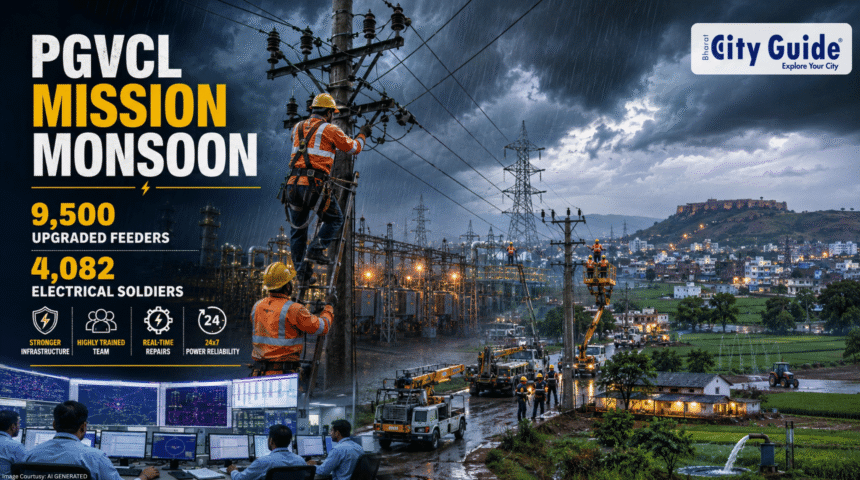
The announcement of the current scale of the PGVCL Mission Monsoon matters because it establishes a new benchmark for public utility accountability and resilience in India. By proactively upgrading a staggering 9,500 power feeders across Saurashtra and putting a dedicated army of 4,082 specialized personnel on high alert, PGVCL is actively reducing the projected duration of power cuts from days to mere minutes.
Furthermore, the utility’s bold commitment to conducting fault repairs dynamically—even during active rainfall where safety parameters permit—showcases a paradigm shift in workforce readiness and operational courage. For a region that frequently bears the brunt of Arabian Sea cyclones and torrential monsoon depressions, this level of preparedness is not just a structural upgrade; it is an essential public safety shield.
Background Information
To fully appreciate the scale of the PGVCL Mission Monsoon, one must understand the unique geographical and institutional context of the Paschim Gujarat Vij Company Limited. PGVCL is one of the largest discoms (distribution companies) in Gujarat, covering an expansive territory that includes the entire Saurashtra peninsula, the vast salt deserts of Kutch, and surrounding districts. This territory is characterized by a long, vulnerable coastline, dense industrial clusters in cities like Rajkot, Jamnagar, and Morbi, and millions of scattered agricultural connections.
Historically, the distribution network in Saurashtra has relied heavily on overhead lines, making it highly susceptible to weather-related hazards. During past monsoons and severe cyclonic storms like Cyclone Tauktae or Cyclone Biparjoy, the region suffered unprecedented damage to its power infrastructure. Thousands of electricity poles were bent like matchsticks, and hundreds of transformers were submerged or blown out by lightning.
Learning from these recurring natural adversities, PGVCL began shifting toward a structural resilience model. The state government recognized that standard, piecemeal maintenance was insufficient for handling the localized impacts of climate change, which have caused increasingly unpredictable and intense rainfall patterns. This structural evolution culminated in the specialized formulation of the Mission Monsoon framework, turning seasonal maintenance into a rigorous, data-driven engineering campaign.
Key Highlights
The scale of this year’s monsoon preparedness operation is reflected in its key metrics:
- 9,500 Feeders Upgraded: Comprehensive maintenance, load-balancing, and structural stabilization completed across nearly ten thousand power feeders throughout Saurashtra.
- 4,082 ‘Electrical Soldiers’ Deployed: A massive, highly trained workforce consisting of engineers, linesmen, and technicians placed on round-the-clock alert.
- Dynamic Fault Repair: Implementation of special protocols allowing teams to diagnose and fix localized electrical faults during ongoing rainfall, utilizing advanced safety gear.
- Pre-Monsoon Tree Trimming & Clearing: Elimination of thousands of potential hazards by trimming tree limbs encroaching upon high-tension and low-tension overhead lines.
- Substation Weatherproofing: Elevated positioning and sealing of vulnerable transformers and control panels to prevent rainwater ingress and short-circuiting.
- Material Stockpiling: Strategic placement of spare poles, transformers, conductors, and underground cables at localized depots for rapid replacement deployment.
Detailed Explanation of the Event
The execution of the PGVCL Mission Monsoon is divided into distinct, highly coordinated phases: the Pre-Monsoon Maintenance Phase, the Real-Time Monitoring Phase, and the Dynamic Restoration Phase.
The Pre-Monsoon Maintenance Phase
Long before the monsoon arrived, PGVCL engineers mapped out the region’s most vulnerable feeders. A feeder is an electrical line that transmits power from a generating station or substation to localized distribution transformers. By targeting 9,500 feeders, PGVCL effectively blanketed almost the entirety of Saurashtra’s distribution network.
Teams replaced old, frayed conductors with high-tensile, insulated cables less likely to snap under wind pressure. Weak wooden or older concrete poles were systematically replaced with robust, high-strength support structures. Additionally, specialized insulation coatings were applied to prevent current leakages caused by moisture and salt-crust accumulation, a common issue in coastal Saurashtra.
Mobilization of the ‘Weej Sainiks’ (Electrical Soldiers)
The human element of this mission is its most vital component. PGVCL has organized a workforce of 4,082 personnel, colloquially termed ‘Electrical Soldiers’ or Weej Sainiks. These individuals are divided into localized quick-response teams stationed across strategic grid nodes.
These teams operate under a rotating 24/7 shift system, ensuring that an optimal number of technical personnel are awake and ready to deploy at any hour of the night during a storm.
Innovating with On-the-Go Repairs
Traditionally, when a power line trips during a heavy downpour, utility companies wait for the rain to stop before sending out repair crews to avoid electrocution risks. Under the strict safety guidelines of the current Mission Monsoon framework, PGVCL has equipped its teams with specialized waterproof testing equipment, non-conductive safety ladders, and high-grade personal protective equipment (PPE). This setup allows technicians to safely isolate faults and perform repairs during active rainfall, drastically reducing the cumulative duration of regional blackouts.
Benefits and Crucial Features of the Upgrades
The comprehensive overhaul under the PGVCL Mission Monsoon brings several structural and operational advantages to the regional grid:
1. Drastic Reduction in Aggregated Outage Time
By upgrading feeders and using specialized diagnostic tools, the time required to locate a fault is cut down significantly. Instead of patrolling miles of lines in the mud to find a snapped wire, digitized feeder telemetry helps engineers isolate the affected section instantly.
2. Enhanced Public Safety
Snapped, live wires lying in monsoon puddles pose a lethal hazard to pedestrians and livestock. The structural reinforcement of lines and the introduction of automated circuit breakers mean that if a wire does snap, power to that specific line is cut off instantly within milliseconds, eliminating the risk of accidental electrocution.
3. Protection of Industrial Productivity
Saurashtra houses vital industrial areas, including brass components manufacturing in Jamnagar, clock and vitrified tiles industries in Morbi, and machine tools manufacturing in Rajkot. Unstable power or frequent voltage fluctuations can destroy sensitive industrial machinery and disrupt manufacturing cycles. A stabilized monsoon grid preserves economic output.
4. Agricultural Stability
Monsoons in Gujarat often feature dry spells where crops still require supplemental irrigation. By keeping agricultural feeders functioning reliably, PGVCL ensures that farmers can run their water pumps whenever needed without fear of single-phase motor burnouts caused by voltage drops.
How It Impacts People
| Segment of Society | Direct Positive Impacts of PGVCL Upgrades |
|---|---|
| General Citizens & Households | Reliable home cooling, food preservation in refrigerators, continuous internet connectivity, and safer, well-lit streets during storms. |
| Industrialists & Business Owners | Prevention of operational downtime, elimination of expensive diesel generator costs, and timely completion of export orders. |
| Farmers & Rural Communities | Protection of expensive tube-well motors from voltage surges and reliable power availability during critical crop watering phases. |
| Healthcare Infrastructure | Uninterrupted operation of life-support systems, ventilators, and cold-storage units for vital vaccines without dependency on backup failure rates. |
For urban residents, it means the end of unexpected dark hours spent waiting for the weather to clear. For rural communities, it bridges the gap between urban and rural infrastructure quality, ensuring that small villages receive the same rapid fault-rectification response as major municipal corporations.
Expert Insights and Industry Perspective
Power distribution experts emphasize that seasonal infrastructure hardening is the most cost-effective method for mitigating climate risk. Power sector analysts point out that utilities that invest heavily in pre-monsoon maintenance experience up to 40% fewer emergency equipment failures compared to utilities that follow a purely reactive, breakdown-centric maintenance model.
Engineers specializing in grid management highlight that upgrading feeders is equivalent to widening and reinforcing the foundational pillars of a highway. When the main transmission channels are secure, the downstream distribution network experiences fewer systemic collapses.
Industry veterans also praise the institutional branding of field workers as ‘Electrical Soldiers.’ This recognition acknowledges the hazardous conditions these individuals face, boosting workforce morale and fostering accountability and pride during stressful emergency deployments.
Challenges and Limitations
Despite the meticulous planning behind the PGVCL Mission Monsoon, certain unavoidable operational challenges persist:
- Extreme Localized Weather Events: While upgrades protect against standard heavy rainfall, sudden cloudbursts, severe lightning arrays, or localized tornadic winds can still cause physical damage that no overhead grid can withstand.
- Geographical Obstacles: In rural Saurashtra, mud logging, washed-out dirt roads, and flooded fields make it physically difficult for repair vehicles carrying heavy replacement poles or transformers to reach fault sites quickly.
- Safety Constraints during Torrential Downpours: While teams are trained to repair faults during rain, high-voltage maintenance remains impossible during severe electrical lightning storms due to safety protocols protecting human lives.
- Densely Populated Urban Areas: In the old, congested quarters of cities like Rajkot or Bhavnagar, narrow lanes and hanging private overhead wires hamper the movement of PGVCL crane trucks and maintenance equipment.
Future Outlook
Looking ahead, the future of power distribution in Saurashtra lies in automation and underground cabling. The extensive work completed under the current PGVCL Mission Monsoon serves as a bridge toward an automated smart grid environment. Over the next few years, PGVCL plans to convert vulnerable overhead lines in coastal towns into completely subterranean underground network corridors, completely shielding them from wind and rain damage.
Additionally, the integration of Supervisory Control and Data Acquisition (SCADA) systems is being expanded. In future monsoon seasons, the grid will feature self-healing capabilities, where automated switches can reroute power through alternate pathways if a particular feeder line goes down. This will further reduce human intervention and advance toward the goal of zero-downtime power resilience.
Frequently Asked Questions (FAQs)
Q1: What is the primary goal of the PGVCL Mission Monsoon?
The primary goal is to ensure a continuous, safe, and reliable power supply across the Saurashtra and Kutch regions during the harsh monsoon season by proactively upgrading infrastructure and deploying rapid-response teams.
Q2: How many power feeders have been upgraded under this mission?
PGVCL has successfully maintained, structurally reinforced, and upgraded over 9,500 power feeders across its operational grid network.
Q3: Who are the ‘Electrical Soldiers’ mentioned in the project?
They are a dedicated workforce of 4,082 technical professionals, including field engineers, linesmen, and safety technicians, organized into rapid-response teams to resolve electrical faults around the clock.
Q4: Will PGVCL really repair electricity faults while it is raining?
Yes. Equipped with specialized, non-conductive safety gear, waterproof testing equipment, and distinct operational protocols, teams will dynamically repair localized faults during ongoing rainfall, provided conditions do not violate critical human safety limits.
Q5: How does this mission benefit the industrial sectors of Saurashtra?
By minimizing voltage fluctuations, preventing long-term blackouts, and stabilizing power delivery, the mission protects heavy machinery from damage and saves industries from costly production delays.
Q6: What precautions should citizens take during monsoon power disruptions?
Citizens should stay away from fallen electrical poles, avoid touching damp walls near service meters, report sparking lines immediately to the PGVCL helpline, and keep electronic appliances unplugged during heavy lightning storms.
Q7: How can consumers log a complaint during a monsoon power outage?
Consumers can use PGVCL’s centralized 24/7 toll-free helpline numbers, localized sub-division complaint centers, or their official digital application platforms to log instantaneous power fault complaints.
Conclusion
The PGVCL Mission Monsoon stands as a prime example of proactive governance and infrastructural foresight. By systematically upgrading 9,500 power feeders and keeping a dedicated force of 4,082 ‘Electrical Soldiers’ on high alert, PGVCL is changing the narrative around seasonal power reliability in Saurashtra.
While the natural elements will always pose challenges, this comprehensive preparation ensures that the region’s homes, fields, and factories remain powered through the storm. As climate patterns demand greater resilience from public utilities, the structured execution of the PGVCL Mission Monsoon offers an effective model for power distribution companies across India.