Introduction
The Indian military ecosystem is on the verge of a historic structural transition. Launched with the vision of transforming India’s defense forces into a lean, agile, and technologically superior fighting unit, the Agnipath Scheme is currently capturing national headlines. The primary driver behind this sudden spike in public interest is a highly anticipated development: the very first batches of Agniveers, who were inducted into training back in early 2023, are reaching the final stages of their four-year tenure later this year in 2026.
- Introduction
- What is the Agnipath Scheme?
- Current Situation and the Latest Retention Updates
- Why is an Increased Retention Limit Crucial for India?
- Key Highlights of the Agnipath Scheme Framework
- Technical and Operational Details of the Agniveer Profile
- Structural Advantages of the Proposed Policy Shift
- Disadvantages and Operational Challenges of the Scheme
- Future Expectations and Strategic Outlook
- Frequently Asked Questions (FAQs)
- Conclusion
As this critical milestone approaches, a pivotal question dominates national security debates and barracks alike: Will more than 25 percent of these young soldiers be retained permanently? Reports emanating from high-level defense circles indicate that a major overhaul of the retention policies under the Agnipath Scheme is being actively deliberated. With the Indian Army, Navy, and Air Force evaluating their operational readiness, manpower requirements, and specialized technological needs, the pressure to expand the permanent cadre has never been greater. For lakhs of defense aspirants and currently serving youth, this article provides an exhaustive, well-researched, and completely objective breakdown of the proposed updates, official perspectives, and the future trajectory of India’s premier military recruitment model.
What is the Agnipath Scheme?
The Agnipath Scheme was officially unveiled by the Government of India in June 2022, marking a radical departure from the traditional, long-term military recruitment systems that had been in place for decades. Designed specifically for recruiting personnel below officer ranks (PBOR) across the Indian Army, Indian Navy, and Indian Air Force, the scheme opens up a unique four-year window for Indian youth.
Historical Context and Background
Before the implementation of this system, Indian jawans were recruited through traditional rallies and institutional exams, offering a minimum of 15 to 17 years of active service accompanied by lifelong pension benefits. However, as modern warfare increasingly shifted toward digitization, artificial intelligence, cyber capabilities, and drone technology, the top brass recognized a pressing dual challenge:
- The Age Profile Dilemma: The average age of an Indian combat soldier hovered around 32 years. Defense planners sought to drop this average to approximately 26 years to match global benchmarks for high-altitude agility and peak physical endurance.
- The Fiscal Imbalance: A massive chunk of India’s annual defense budget was being consumed by the ballooning revenue expenditure, specifically salaries and pension payouts. This left fewer financial resources for capital acquisition—such as purchasing modern fighter jets, advanced submarines, and state-of-the-art infantry rifles.
Core Architecture of the Model
Under the ongoing rules of the Agnipath Scheme, candidates between the ages of 17.5 and 21 years are recruited as “Agniveers” for a fixed tenure of four years. This timeline includes an intensive six-month initial training period followed by 3.5 years of active operational deployment. Upon completion of this contract, the initial policy mandated that a maximum of 25 percent of the batch would be granted a permanent 15-year commission in the regular cadre based on strict internal merit, physical fitness, and operational performance. The remaining 75 percent are transitioned back into civilian life with a comprehensive, tax-free financial cushion known as the Seva Nidhi package, alongside distinct skill certificates to optimize their secondary career opportunities.
Current Situation and the Latest Retention Updates
The ground reality of the Agnipath Scheme is shifting fast as internal assessments highlight the immense practical value of these trained personnel. According to highly authoritative reports published by major media houses like The Indian Express, the three branches of the Armed Forces are actively presenting a strong case to the Department of Military Affairs (DMA) to dramatically upscale the retention limits.
The current structural proposals and ongoing adjustments across the different branches highlight the momentum toward higher retention:
1. Indian Navy Pushing for 75% Retention
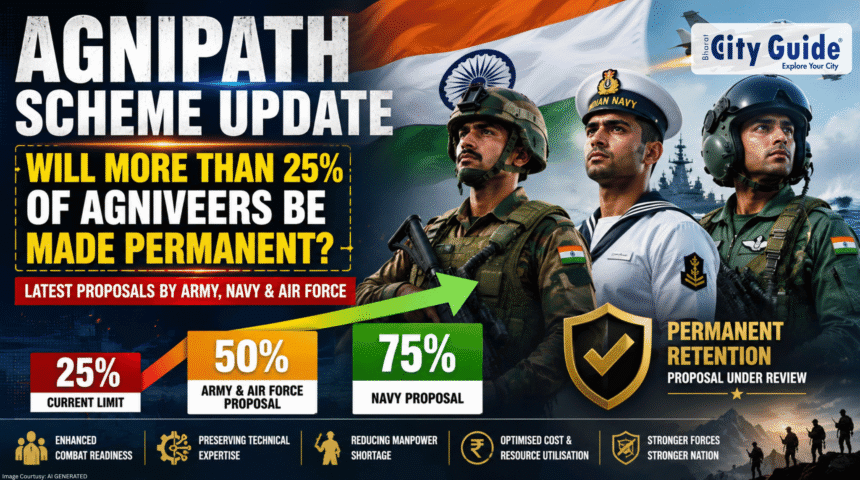
The Indian Navy faces an incredibly steep technical learning curve. Operating sophisticated warships, navigating advanced sonar networks, maintaining nuclear submarines, and managing naval aviation electronics require deep, specialized expertise that cannot be fully mastered or optimally utilized in just 3.5 years of active deployment. Consequently, the Navy is reportedly seeking the most aggressive policy shift, expressing a desire to retain up to 75 percent of its Agniveer sailors permanently.
2. Indian Army and Air Force Proposing 50% Retention
The Indian Army and the Indian Air Force (IAF) are moving along a similar trajectory. Both forces are looking to double the existing permanent recruitment quota, requesting an increase from the current 25 percent cap to a much more substantial 50 percent limit. The primary driver here is the critical need to preserve an experienced pool of combat-ready troops who have already acclimated to tough counter-insurgency environments, high-altitude border posts, and complex weapon systems.
3. Alternative Expansion via Specialised Units
An intriguing internal detail has emerged regarding fallback options. Sources indicate that even if an immediate, blanket increase in the retention percentage across the entire military is delayed by fiscal evaluations, individual specialized units are preparing to absorb a significantly higher ratio of experienced soldiers.
For instance, the Indian Army’s newly raised, tech-centric Bhairav battalions may eventually feature an extensively higher concentration of permanent, re-enrolled soldiers compared to a standard infantry unit. This ensures that the military retains its technical edge without immediately rewriting the macro-level percentages of the original policy framework.
4. Progress of Recruitment and Training Vacancies
While these discussions are unfolding at the highest bureaucratic echelons, recruitment under the Agnipath Scheme continues at full throttle. In the last training year alone, the Indian Army trained approximately 70,000 Agniveers across its various regimental centers. To aggressively counter a persistent manpower shortfall of nearly 1.8 lakh troops nationwide, the Army plans to release approximately 90,000 vacancies in the upcoming training cycle, scaling up numbers progressively over the next two years.
Why is an Increased Retention Limit Crucial for India?
Modifying the original contours of the Agnipath Scheme to support a 50% to 75% retention rate is not just a populist move to appease critics; it is a calculated operational necessity.
Enhancing Combat Readiness and Experience
A soldier is not made overnight. While a six-month training period equips an Agniveer with fundamental physical conditioning and basic weapon-handling skills, true combat efficiency is forged through real-world experience. By the time an Agniveer completes four years, they have participated in active patrolling, border management, and joint military exercises. Discharging 75 percent of this highly polished human resource means the military is continuously losing its seasoned ground-level tactical experience, only to replace them with fresh, untrained recruits. Bumping the retention up to 50 percent stabilizes unit cohesion at the battalion level.
Mastering Modern Military Technology
Modern warfare is highly technical. From operating software-defined radios and anti-drone jamming systems to interpreting real-time satellite telemetry, modern jawans must act as tech-savvy warriors. A higher permanent retention rate ensures that the heavy financial and temporal investments made by the state in training these youth to handle multi-million dollar defense systems yield long-term operational dividends.
Addressing Manpower Shortfalls Safely
The complete suspension of traditional recruitment during the COVID-19 pandemic, coupled with the natural retirement of older regular soldiers, has left noticeable gaps in institutional troop strength. By raising the permanent absorption rate, the armed forces can rapidly plug the structural deficit of nearly 1.8 lakh personnel without compromising on the quality or operational experience of the troops occupying forward defense lines along the Line of Control (LoC) and the Line of Actual Control (LAC).
Key Highlights of the Agnipath Scheme Framework
To understand how a potential shift to a 50 percent permanent model will transform the system, it is vital to map out the foundational building blocks of the current Agnipath Scheme framework:
- Age Criteria: Open exclusively to young citizens between 17.5 and 21 years of age, ensuring a young and agile physical profile across all frontline units.
- Tenure of Service: A definitive four-year engagement matrix consisting of 6 months of streamlined training and 3.5 years of active duty service.
- The Permanent Cadre Pathway: Under initial guidelines, 25 percent are permanently re-enrolled into the regular cadre for an additional 15 years based on organizational performance metrics.
- The Seva Nidhi Package: A lucrative, tax-free exit corpus of approximately ₹11.71 lakh, accumulated via a 30% monthly salary contribution from the soldier, matched rupee-for-rupee by the Central Government.
- Comprehensive Life Insurance Cover: A non-contributory life insurance cover of ₹48 lakh provided for the entire duration of the four-year service stint.
- Ex-Gratia Disability Compensation: Up to ₹44 lakh in financial aid for operational disability, categorized rigorously based on the percentage of physical impairment suffered on duty.
- Post-Service Resettlement Support: Dedicated structural reservations, including a significant policy shift by the Union Home Ministry to scale up reservations for ex-Agniveers in Group C posts within Central Armed Police Forces (CAPFs) and the Assam Rifles up to 50%, alongside exemptions from physical efficiency tests (PET).
Technical and Operational Details of the Agniveer Profile
When discussing the Agnipath Scheme, it is highly useful to evaluate the technical, financial, and operational parameters governing an individual Agniveer’s career trajectory.
Financial and Compensation Matrix
| Year of Service | Monthly Customised Package (Gross) | In-Hand Salary Component (70%) | Contribution to Agniveer Corpus Fund (30%) |
|---|---|---|---|
| 1st Year | ₹30,000 | ₹21,000 | ₹9,000 |
| 2nd Year | ₹33,000 | ₹23,100 | ₹9,900 |
| 3rd Year | ₹36,500 | ₹25,550 | ₹10,950 |
| 4th Year | ₹40,000 | ₹28,000 | ₹12,000 |
Crucial Exit Benefit: Upon completing the 4th year, the total accumulated contribution of ₹5.02 lakh by the soldier, combined with the matching ₹5.02 lakh government contribution plus accumulated interest, culminates in the final Seva Nidhi Package of approximately ₹11.71 Lakh.
Operational Specifications and Allowances
- Leave Entitlements: Agniveers receive a streamlined allowance of 30 days of annual leave per year, supplemented by medical leave based on authenticated military hospital recommendations.
- Risk and Hardship Allowances: Agniveers receive risk, clothing, ration, and travel allowances at exact parity with regular soldiers serving in identical operational zones (e.g., high-altitude deployments like the Siachen Glacier).
- Medical Benefits: Full access to standard military medical facilities and service hospitals for the entire duration of their four-year service contract.
Structural Advantages of the Proposed Policy Shift
If the Government approves the recommendations to elevate permanent absorption rates, it will bring several distinct advantages to the Indian defense paradigm:
- Boosts Grassroot Troop Morale: Knowing that they have a 50% to 75% mathematical chance of securing a permanent, lifetime career in the armed forces will radically alleviate mental stress among young Agniveers, drastically driving up their field performance and focus.
- Saves National Re-Training Costs: Retaining an already experienced soldier eliminates the recurring financial expenditure of initiating fresh basic recruitment cycles, physical screenings, and baseline training protocols for entirely new batches.
- Mitigates Social Concerns: One of the sharpest criticisms faced by the Agnipath Scheme from opposition parties was the fear of large groups of 22-year-old disciplined youth entering the civilian job market without long-term financial security. Doubling the retention framework immediately neutralizes this social anxiety.
- Optimized Civilian Transition: For the percentage of troops that do exit, the MHA’s upgraded 50% reservation matrix in CAPFs (such as BSF, CRPF, and CISF), along with direct exemptions from physical endurance rounds, guarantees an elite, battle-hardened pipeline for internal national security.
Disadvantages and Operational Challenges of the Scheme
Despite the highly positive prospects of an increased permanent quota, the structural framework of the Agnipath Scheme still encounters certain localized criticisms and operational bottlenecks:
- Lack of Regular Pension Rights for Non-Retained Troops: The 50% of troops who return to civilian life after four years do not qualify for a lifelong military pension, healthcare via ECHS, or formal Ex-Servicemen (ESM) status, which remains a core point of political friction.
- Risk of Initial Inexperience in Critical Units: Relying heavily on short-term recruits during the initial 3.5 years of active duty can occasionally strain the tactical equilibrium of deep-combat units that depend heavily on split-second, instinctual trust born out of long, shared tenures.
- Heavy Administrative Assessment Burden: Designing and executing an absolutely transparent, corruption-free, and hyper-objective performance grading matrix to filter out the top 50 percent of a batch requires massive administrative hours and creates intense internal competition among peer groups.
Future Expectations and Strategic Outlook
As the debate intensifies, the future of the Agnipath Scheme appears highly dynamic. The Department of Military Affairs is systematically evaluating the detailed proposals sent by the three wings of the armed forces. Given the geopolitical challenges on India’s northern and western borders, maintaining absolute combat proficiency is non-negotiable.
Moving forward, defense analysts expect a balanced structural compromise. The government might announce a tiered retention model—allowing up to 75% retention for highly technical arms like naval engineering, aviation maintenance, and cyber-warfare divisions, while stabilizing infantry and standard artillery corps at a comfortable 50% absorption rate. This calibrated optimization preserves the primary policy goal of reducing the overall age profile of the fighting forces, while successfully preventing a sudden drain of vital combat experience.
Frequently Asked Questions (FAQs)
1. What is the current permanent retention limit under the Agnipath Scheme?
Under the current official regulations of the Agnipath Scheme, up to a maximum of 25 percent of the total recruited Agniveers in any given batch can be absorbed into the regular regular cadre of the Indian Armed Forces after completing their four-year tenure. This selection is based completely on a competitive merit list tracking physical fitness, discipline, and operational performance during their active service years. The remaining 75 percent are discharged into civilian life.
2. Is it officially confirmed that the Agniveer permanent retention will be increased to 50%?
As of right now, an increase to 50% or 75% retention remains a formal proposal undergoing active review and discussion within the Armed Forces and the Department of Military Affairs (DMA). While major reports indicate that the Indian Army and Air Force want a 50% retention rate and the Navy is seeking up to 75%, an official, final announcement from the Ministry of Defence has not yet been formally enacted.
3. What benefits do Agniveers get after completing their 4-year tenure?
Upon completing their four-year term under the Agnipath Scheme, Agniveers who do not transition into the regular permanent cadre receive the tax-free Seva Nidhi package worth approximately ₹11.71 lakh. They are also awarded an official ‘Agniveer Skill Certificate’ and a detailed Vidya Kaushal log to facilitate smooth secondary placements, alongside massive reservation quotas in various state police forces and Central Armed Police Forces (CAPFs).
4. Are ex-Agniveers eligible for regular military pensions or medical benefits?
No, the Agniveers who exit the service after their standard four-year contract under the Agnipath Scheme do not receive a lifelong retirement pension, nor do they qualify for regular post-retirement Ex-Servicemen (ESM) medical benefits. However, the 25 percent (or the proposed higher percentage) who are successfully selected for the permanent cadre will receive the standard pay scales, ranks, pensions, and medical benefits applicable to regular soldiers.
5. Why are the Indian Army, Navy, and Air Force demanding a higher retention rate?
The primary reason the armed forces are seeking an upgrade to the Agnipath Scheme retention limits is to preserve operational experience and technical expertise. Modern warfare relies on highly advanced systems, and a longer retention window ensures that the massive investments made in training these soldiers to handle cutting-edge weaponry, electronic systems, and naval vessels are not lost rapidly every four years.
6. Can an Agniveer join the Central Armed Police Forces (CAPFs) after four years?
Yes, absolutely. The Union Home Ministry has drastically optimized the civilian transition pathway by creating a dedicated 10% to 50% structural reservation for ex-Agniveers inside Group C posts across elite internal security forces like the BSF, CRPF, CISF, and ITBP. Furthermore, ex-Agniveers are granted relaxation in the upper age limits and are completely exempted from the standard Physical Efficiency Tests (PET).
7. How does the Agnipath Scheme help reduce the average age of the military?
The traditional recruitment models brought in jawans for regular 15-to-17-year contracts, keeping the average age profile of the armed forces around 32 years. By recruiting youth between 17.5 and 21 years for a concise four-year term, the Agnipath Scheme systematically injects fresh, younger blood into frontline combat units, successfully driving down the average age of an active combat soldier to approximately 26 years.
Conclusion
The Agnipath Scheme remains one of the most transformative, talked-about, and strategically vital defense reforms initiated in modern Indian history. While its rollout was met with socio-political debates and intense scrutiny, its structural evolution highlights the flexibility of India’s defense planning. The latest internal proposals by the Army, Navy, and Air Force to scale up the permanent absorption of Agniveers from 25 percent to up to 50 and 75 percent show that the leadership is highly responsive to operational ground realities.
By expanding the permanent retention limits, the government can successfully marry fiscal prudence with peak operational combat readiness. It satisfies the military’s urgent need for experienced, tech-savvy combatants, addresses long-standing troop shortages, and offers a highly reassuring career pathway for the nation’s patriotic youth. As the first batches prepare for their release cycle later this year in 2026, all eyes are on the Ministry of Defence for the final policy sign-off, which promises to reshape the future of India’s armed forces for generations to come.
To see a deeper visual breakdown of how these proposed policy updates match up with ground-level troop requirements and internal assessments, you can check out this comprehensive Agniveer Policy Shift Analysis Video. This video provides helpful context on the structural adjustments being discussed across different military wings.