Introduction: In Budget EVs, Charging Strategy Matters More Than the Charger Brand
When Indians shop for electric cars under ₹10 lakh in 2026—Tiago.ev, MG Comet EV, Tata Punch.ev Smart, Vayve Eva, or upcoming VF3-type mini EVs—the biggest mistake buyers still make is overthinking range and underthinking charging.
- Introduction: In Budget EVs, Charging Strategy Matters More Than the Charger Brand
- 1. Home Charging – The Main Weapon of Budget EV Ownership
- 2. Society & Apartment Charging – The Second Line of Support
- 3. Public & Highway Charging – Use Sparingly, Use Smart
- 4. Matching Charger Strategy to Each Budget EV
- 5. Cost & Time Snapshot (25–30 kWh Budget EV)
- 6. Practical Setup Recommendation (2026 Budget EV Owner)
- Conclusion: Charging Smart Is the Real EV Upgrade
- FAQs – EV Charging for Budget Cars (India 2026)
- Reader Question
Here’s the truth:
👉 For affordable EVs, the right charging strategy is more important than battery size, charger brand, or even fast-charging speed.
If your charging setup matches your usage, even a small-battery EV feels stress-free.
If it doesn’t, even a “400 km range” EV will feel frustrating.
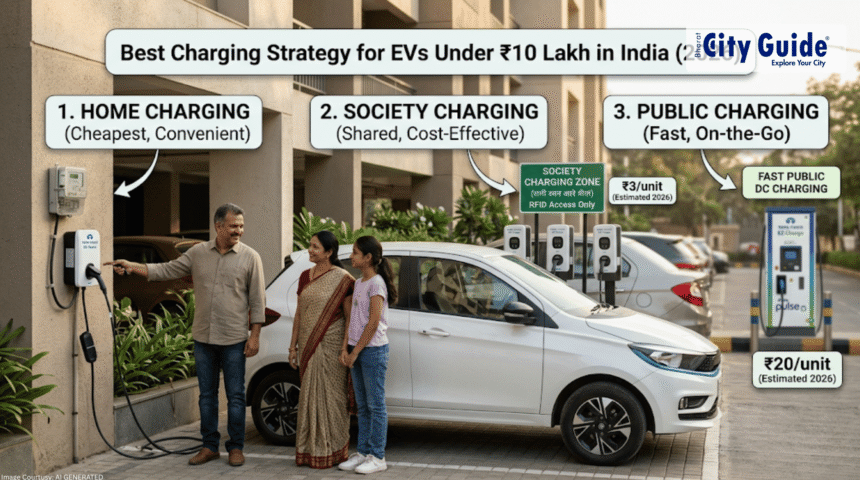
The smartest way to think about EV charging in India today is three layers:
- Home charging (primary layer – must-have if possible)
- Society or workplace charging (support layer)
- Public & highway charging (emergency + long-trip layer)
Let’s break this down clearly, practically, and realistically for 2026 India.
1. Home Charging – The Main Weapon of Budget EV Ownership
For EVs under ₹10 lakh, 90–95% of charging should ideally happen at home.
This is where EV ownership becomes:
- Cheap
- Predictable
- Anxiety-free
Why Home Charging Is Non-Negotiable
Most budget EV buyers drive:
- 30–60 km per day
- Mostly within city limits
- With long idle time at night
That’s perfect for overnight charging.
Once you plug in at night and wake up to a “full tank,” range anxiety almost disappears.
3.3 kW AC Home Charger – The Default, Sensible Choice
This is the standard charger bundled with most sub-₹10 lakh EVs in India.
What It Offers
- Power output: 3.3 kW
- Charging time (25–30 kWh battery): 8–10 hours
- Ideal usage: Overnight charging
For cars like:
- Tata Tiago.ev
- MG Comet EV
- Tata Punch.ev (base)
- Vayve Eva–type micro EVs
This charger is perfectly sufficient.
Expert Reality Check
If your daily driving is 40–50 km, a 3.3 kW charger replaces that energy in 2–3 hours.
The rest of the night is just battery topping and balancing.
👉 In most Indian homes, 3.3 kW is not “slow”—it’s optimal.
7.4 kW AC Home Charger – Faster, But Often Overkill
Some buyers are tempted to upgrade immediately to a 7.4 kW wallbox. It sounds future-proof—but it’s not always practical.
What You Need
- Strong wiring
- 32A single-phase support
- Stable electricity supply
Charging Time
- 25–30 kWh pack: 4–5 hours
Who Actually Needs 7.4 kW?
- You drive 80–120 km daily
- Two EVs share the same charger
- You have limited overnight charging time
For most single-EV households, this is luxury, not necessity.
Home Charging Cost Advantage (The Real EV Magic)
Let’s talk money—because that’s why EVs win.
Typical Home Electricity Tariff (2026)
- ₹6–10 per kWh (varies by state)
Example: 30 kWh Battery
- Full charge cost: ₹180–300
- Real-world range: 250–300 km
That’s roughly:
👉 ₹0.7–1.2 per km
Compare that to petrol:
- ₹7–9 per km (even for efficient hatchbacks)
This cost gap exists only if you charge at home regularly.
2. Society & Apartment Charging – The Second Line of Support
Not everyone has a private parking slot or immediate home charger access. Apartment dwellers are common EV buyers in cities.
The good news?
By 2026, society charging is no longer rare.
What Works Best in Apartments
A balanced setup works best:
- 3.3 kW Bharat AC-001 chargers for slow overnight charging
- 7.4–22 kW Type-2 AC wallboxes for quicker daytime top-ups
This supports:
- Cars
- Scooters
- Multiple residents without overloading the grid
Billing & Access (2026 Reality)
Most societies now use:
- RFID cards
- App-based per-kWh billing
This is:
- Cheaper than DC fast charging
- Predictable
- Fair for shared use
For Tiago.ev / Comet / Punch.ev, AC charging at society is more than enough for daily life.
👉 You do NOT need DC charging just to survive city usage.
3. Public & Highway Charging – Use Sparingly, Use Smart
Public charging is not your daily lifeline for budget EVs. It’s your backup plan.
Public Charging Standards in India (2026)
AC Public Chargers (Type-2, 7–22 kW)
- Ideal for malls, offices, hotels
- 1–2 hours = meaningful range top-up
DC Fast Chargers
- Bharat DC-001 (15 kW) – older, slower
- CCS2 (main standard for cars)
Most Indian stations offer 30–50 kW DC, which is enough for budget EVs.
The Cost Reality of Public DC Charging
- DC tariff: ₹18–24 per kWh
- Same 30 kWh charge:
- Home: ₹180–300
- DC fast: ₹540–720
- Home: ₹180–300
That’s 3× more expensive.
If you rely on DC charging daily, you destroy the EV cost advantage.
Best Practice for Sub-₹10L EV Owners
- 80–90% charging at home/society AC
- DC charging only for:
- Highway trips
- Urgent top-ups
- No home charging situations
- Highway trips
4. Matching Charger Strategy to Each Budget EV
Tata Tiago.ev
- Primary: 3.3 kW home AC
- Bonus: 7.4 kW at society/office
- DC: Highway trips only
MG Comet EV
- City-only car
- 3.3 kW home charging is more than enough
- DC charging rarely needed
Tata Punch.ev (Base)
- 3.3 kW home + optional society 7.4 kW
- CCS2 DC for occasional long trips
Vayve Eva–Type Micro EVs
- Small battery
- Simple home AC charging
- Public DC is unnecessary for intended use
VinFast VF3–Class Mini EVs
- Same logic: home AC first, public charging as backup
5. Cost & Time Snapshot (25–30 kWh Budget EV)
| Charger Type | Power | Full Charge Time | Cost per Full Charge | Best Use |
| Home AC | 3.3 kW | 8–10 hrs | ₹180–300 | Daily use |
| Home AC | 7.4 kW | 4–5 hrs | ₹180–300 | Heavy users |
| Public AC | 7–22 kW | 2–5 hrs | ₹250–400+ | Malls/offices |
| Public DC | 30–50 kW | 45–60 min (0–80%) | ₹540–720 | Highways/emergency |
6. Practical Setup Recommendation (2026 Budget EV Owner)
If you’re buying an EV under ₹10 lakh:
- Install a 3.3 kW home charger first
Non-negotiable if you have parking. - Encourage society/workplace charging
One 7.4 kW shared AC charger is a big upgrade. - Register on 2–3 charging apps
Especially those active on your usual highway routes. - Charge smart
- Use night/off-peak tariffs
- Avoid living on DC charging
- Use night/off-peak tariffs
Conclusion: Charging Smart Is the Real EV Upgrade
In 2026 India, budget EV ownership is not about chasing the fastest charger or biggest battery.
It’s about:
- Charging where the car sleeps
- Using AC charging intelligently
- Treating DC fast charging as insurance, not habit
Do this right, and even a modest EV like Tiago.ev or Comet will feel:
- Cheaper than petrol
- Less stressful
- More convenient than you expected
Get it wrong, and EVs will feel expensive and inconvenient—unfairly.
FAQs – EV Charging for Budget Cars (India 2026)
Q1. Is a 3.3 kW charger enough for EVs under ₹10 lakh?
Yes. For 30–60 km daily usage, a 3.3 kW charger easily covers overnight charging.
Q2. Should I upgrade to a 7.4 kW charger at home?
Only if you drive over 80–100 km daily or have two EVs. Otherwise, it’s optional.
Q3. Can I survive without home charging?
Possible, but not ideal. Society or workplace AC charging becomes critical.
Q4. Is DC fast charging bad for the battery?
Occasional use is fine. Frequent reliance increases cost and long-term wear.
Q5. What plugs should my EV support?
- Type-2 AC
- CCS2 DC
These cover almost all public chargers in India.
Reader Question
Given your daily usage and access to parking, would you personally stick with a 3.3 kW home charger, or would you seriously pay extra for a 7.4 kW wallbox—and why?